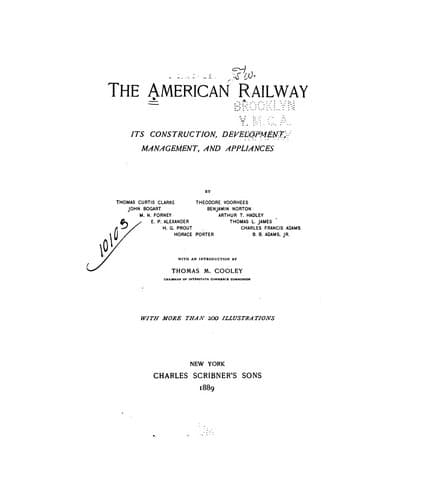
The American Railway: Its Construction, Development, Management, and AppliancesClarke, Thomas Curtis
History
The American Railway: Its Construction, Development, Management, and Appliances
Clarke, Thomas Curtis
Railroads -- United States
A word or two as to the methods by which such operations are
carried on, and the system which makes them possible. From the very
first, railroads have been built and operated by corporations.
A number of investors, too large to attend personally to the
management of the enterprise, took shares of stock and elected
officers to represent them. These officers had almost absolute
power; but while matters were in this simple stage, there was no
great opportunity for its abuse. The losses of investors were
due to _bona fide_ errors of judgment rather than to misuse of
power. But soon the corporations found it convenient to borrow
money by mortgaging their property. We then had two classes of
investors--stockholders and bondholders, the former taking the
risks and having the full control of the property, the latter
receiving a relatively sure though perhaps smaller return, but
having no control over the management as long as their interest was
regularly paid.
Of course there is always some danger when the men who furnish
the money do not have much control of the enterprise; but as long
as the relations of stock and bonds were in practice what they
pretended to be in theory, the resulting evils were not very
great. Matters soon reached another stage. The amount of money
furnished by the bondholders increased out of all proportion to
that furnished by the stockholders. Sometimes the nominal amount of
stock was unduly small; more commonly only a very small part of the
nominal value was ever paid in.[28] The stock was nearly all water,
simply issued by the directors as a means of keeping control of the
property. After the crisis of 1857, people had become shy of buying
railroad stock; but they bought railroad bonds because they thought
they were safe. This was the case only when there was an actual
investment of stockholders behind them; without this assurance,
bonds were more unsafe than stock had been, because the bondholders
had still less immediate control over the directors and officials.
If there was money to be made at the time, the directors made it;
if there was loss in the end, it fell upon the bondholders.
Public-domain text, read in full here on John Shaqi.
Reviews
Reviews
No reviews yet
Be the first to share your thoughts on this work.
Elsewhere in the archive
Join the Discussion
Join the discussion
Sign in to leave a comment or review.
Sign InorCreate an account