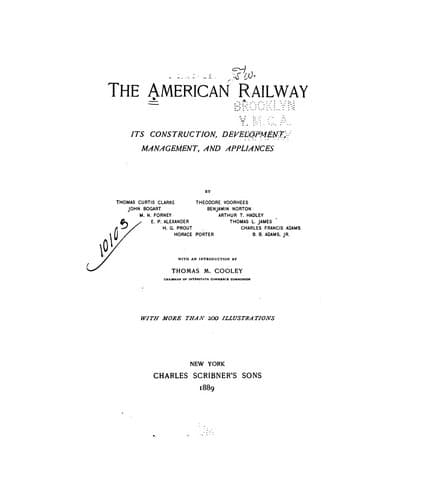
The American Railway: Its Construction, Development, Management, and AppliancesClarke, Thomas Curtis
History
The American Railway: Its Construction, Development, Management, and Appliances
Clarke, Thomas Curtis
Railroads -- United States
In cases like the one just described the bondholders are largely to
blame for their own folly. But sometimes the loss falls on those
who are in no way responsible for it. A railroad may be built as a
blackmailing job. If a company is sound and prosperous, speculators
may be tempted to build a parallel road, not with the idea of
making it pay, but because they can so damage the business of the
old road as to force it to buy them out. They build the road to
sell.
It is but fair to say that operations as bad as those just
described are the exception rather than the rule. But the fact that
they can exist at all is by no means creditable to our financial
methods. The whole system by which directors can use their
positions of trust to make contracts in which they are personally
interested puts a premium on dishonesty. Such contracts are
forbidden in England. It may be true, as is urged by many railroad
officials of undoubted honesty, that it would be inconvenient to
apply the same law here; but on the whole, the gain would far
outweigh the loss.
At the very best, a railroad president is subject to temptations
to misuse his financial powers, all the more dangerous because it
is impossible to draw the line between right and wrong. He knows
the probable value of his railroad and of the property affected
by its action a great deal better than any outsider possibly can.
The published figures of earnings of the road are the result of
estimates by himself and his subordinates. Out of the current
earnings he pays current expenses, and probably charges permanent
expenditures to capital account. But what expenditures are current
and what are permanent? This division is itself the result of
an estimate, and a very doubtful one at that. There are some
well-established general principles, but none which will apply
themselves automatically. With the best will in the world he cannot
make his annual reports give a thoroughly clear idea of what has
been done. Is he to be forbidden to buy stock when it seems too
low, or sell it when it is high? Shall we refuse him the right
to invest in other property which he sees will advance in value?
Apparently not; and yet, if we allow this, we open the door for
some of the worst abuses of power which have occurred in railroad
history. The line between good faith and bad faith in these matters
is a narrow one, and the average conscience cannot be trusted to
locate it with accuracy.
Public-domain text, read in full here on John Shaqi.
Reviews
Reviews
No reviews yet
Be the first to share your thoughts on this work.
Elsewhere in the archive
Join the Discussion
Join the discussion
Sign in to leave a comment or review.
Sign InorCreate an account