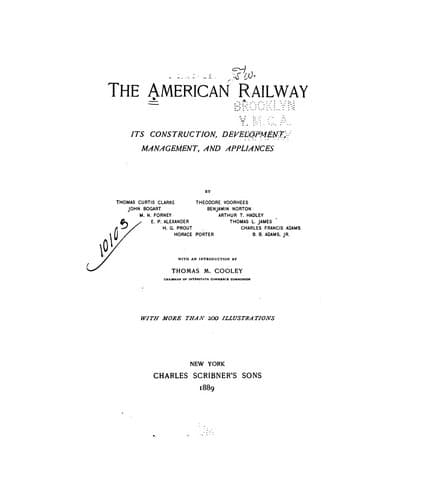
The American Railway: Its Construction, Development, Management, and AppliancesClarke, Thomas Curtis
History
The American Railway: Its Construction, Development, Management, and Appliances
Clarke, Thomas Curtis
Railroads -- United States
But the relations to the investors cover but a small part either
of the work or of the responsibility of the railroad authorities.
They are managing not merely a piece of property, but a vast and
complicated organization of men, and an instrument of public
service. In all these capacities their cares are equally great.
The operating and the traffic departments are not less important
than the financial department. The relations of the railroad to its
employees, and to the business community at large, are even more
perplexing than its relations to the investors.
Of the questions arising between the railroad and its employees we
are just beginning to realize the full importance. They are not
matters to be settled by private agreement or private war. If they
involve a serious interruption of the business of the community
they concern public interests most vitally. The community cannot
afford to have its business interrupted by railroad strikes. On
the other hand, it cannot allow the men to make this public duty
of the railroads a means of enforcing their own will on every
occasion, to the detriment of all discipline and responsibility, or
in disregard of investors' rights. How to compromise between these
two conflicting requirements is one of the most serious problems of
the immediate future.[29] Little progress in this direction has as
yet been made, or even systematically attempted.
The questions arising from the relations of the railroads to those
who use them are wider and older. From the very outset attempts
were made to regulate railroad charges by law in various ways.
The fear at that time was that they might be made unreasonably
high. This fear proved groundless. From the outset the rates were
rather lower than had been expected, and much lower than by many
of the means of transportation which railroads superseded. These
low rates caused a great development in business; and this, in
turn, gave a chance for such economy in handling it that rates
went still lower. Each new invention rendered it easier to do a
large business at cheap rates. The substitution of steel rails
for iron, which began shortly after the close of the war, had an
enormous influence in this respect. This was not merely due to the
direct saving in repairs, which, though appreciable, was moderate
in amount. It was due still more to improvements in transportation
which followed. It was found that steel rails would bear heavier
rolling-stock. Instead of building ten-ton cars to carry ten tons
of cargo, companies built twelve-ton cars to carry twenty tons of
cargo, or fourteen-ton cars to carry thirty tons; and they made the
locomotives heavy enough to handle correspondingly larger trains.
A given amount of fuel was made to haul more weight; and of the
weight thus hauled, the freight formed a constantly increasing
proportion as compared with the rolling-stock itself. The system
of rates was adopted to meet the new requirements. Charges were
Public-domain text, read in full here on John Shaqi.
Reviews
Reviews
No reviews yet
Be the first to share your thoughts on this work.
Elsewhere in the archive
Join the Discussion
Join the discussion
Sign in to leave a comment or review.
Sign InorCreate an account