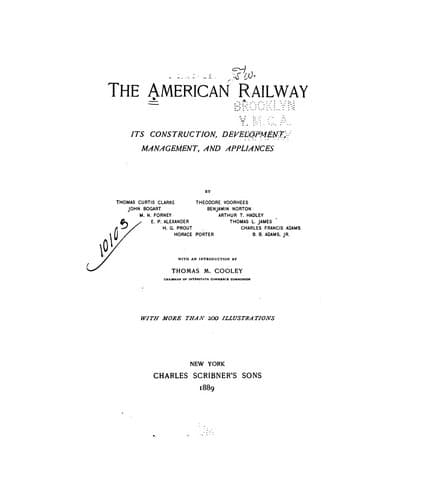
The American Railway: Its Construction, Development, Management, and AppliancesClarke, Thomas Curtis
History
The American Railway: Its Construction, Development, Management, and Appliances
Clarke, Thomas Curtis
Railroads -- United States
made incredibly low in order to fill cars that would otherwise
go empty, or to use the road as nearly as possible to its full
capacity. In the twenty years following the introduction of steel
rails the traffic of the New York Central increased from less than
400,000,000 ton-miles to decidedly over 2,000,000,000; while the
average rates fell from 3.09 cents per ton per mile in 1866 to 0.76
cent in 1886. This is but a single instance of a process which has
gone on all over the country. The average freight charge on all
railroads of the country to-day is a little over one cent per ton
a mile: less than half what would have been deemed possible on any
railroad a few years ago.
The progress of railroad consolidation contributed greatly to
this economy. It saved multiplication of offices; it saved
re-handling of freight; it enabled long-distance business to
be done systematically. So great were its advantages that
co-operation between connecting lines was carried far beyond
the limits of actual consolidation. Through traffic was handled
without transshipment, sometimes by regularly incorporated express
companies or freight companies on the same plan, but more commonly
by what are known as fast-freight lines.[30] These are little more
than combinations for keeping account of through business; they are
by no means ideal in their working, but they have the advantage of
few expenses and no income, so that the temptation to steal, which
is the bane of such organizations, is here reduced to a minimum.
But all these things, while they increased the efficiency of the
service, also increased the power of the railroad authorities
and rendered the shipper more helpless. The very cheapness of
rates only made a recourse to other means of transportation more
difficult. If _A_ was charged 30 cents while his competitor _B_ was
paying only 20 cents for the same service, he was worse off than
when they were both paying a dollar; and the fact that no other
means of conveyance could be found to do the work for less than a
dollar simply put _A_ all the more completely at the mercy of the
railroad freight-agent. In other words, the fact that rates were so
low made any inequality in rates all the more dangerous. The lower
the rate and the wider the monopoly, the less was the chance of
relief.
Public-domain text, read in full here on John Shaqi.
Reviews
Reviews
No reviews yet
Be the first to share your thoughts on this work.
Elsewhere in the archive
Join the Discussion
Join the discussion
Sign in to leave a comment or review.
Sign InorCreate an account