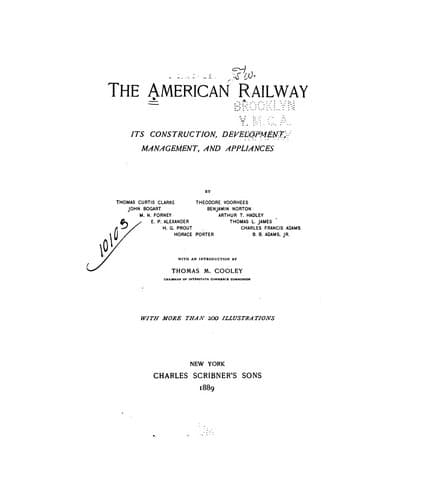
The American Railway: Its Construction, Development, Management, and AppliancesClarke, Thomas Curtis
History
The American Railway: Its Construction, Development, Management, and Appliances
Clarke, Thomas Curtis
Railroads -- United States
We had hardly passed the crisis of the effort to level down, when
some of the more intelligent railroad men made an effort to level
up. Recognizing that discriminations and fluctuating rates were
an evil, they sought to avoid it by common action with regard to
the business at competing points. A mere agreement as to rates to
be charged was not enough to secure this end. Such an agreement
was sure to be violated. Even if the leading authorities meant
to observe it, their agents could always evade its requirements
to some extent. Such evasion was favored by loose arrangements
between connecting roads, and by the somewhat irresponsible system
of fast freight lines. Wherever it existed, it gave rise to mutual
suspicion. _A_ believed that his road did it because he could not
help it, but that _B_ and _C_ were allowing their roads to do
it maliciously; while _B_ and _C_ had the same consciousness of
individual rectitude and the same unkind suspicions with regard to
_A_. It was at best a rather hollow truce, which did not really
accomplish its purpose, and which might change to open war on very
slight provocation.
To avoid this difficulty a pool, or division of traffic, was
arranged. It is a fact that, whatever wars of rates there may be,
the percentage of traffic carried by the different lines varies
but little. If an arbitrator can examine the books and decide what
these percentages have been in the past, he can make an award for
the future, under which the competitive traffic of the different
roads may be fairly divided. The arrangements for doing this are
various. Sometimes the roads carry such traffic as may happen to
be offered, and settle the differences with one another by money
balances; sometimes they actually divert traffic from one line to
another. But the advantage of either of these arrangements over a
mere agreement to maintain rates is that they cannot be violated
without direct action on the part of the leading authorities of
the roads concerned--either in open withdrawal, or in actual
bad faith. The ordinary irregularities of agents do not, under
a pooling system, give rise to much suspicion, because they do
not benefit the road in whose behalf they are undertaken. Its
percentage being fixed there is no motive for rate-cutting. So
great is this advantage that pooling is accepted in almost all
other countries as a natural means of maintaining equality of
rates; the state railroads of Central Europe entering into such
contracts with competing private lines and even with water-routes.
In America itself, pools have had a longer and wider history than
is generally supposed. In New England they arose and continued to
exist on a moderate scale without attracting much attention. In the
Mississippi Valley, the Chicago-Omaha pool was arranged as early as
1870, and formed the model for a whole system of such arrangements
extending as far as the Pacific Coast. But, as involving wider
Public-domain text, read in full here on John Shaqi.
Reviews
Reviews
No reviews yet
Be the first to share your thoughts on this work.
Elsewhere in the archive
Join the Discussion
Join the discussion
Sign in to leave a comment or review.
Sign InorCreate an account