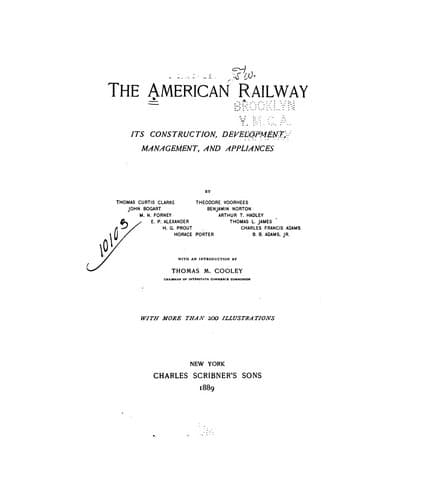
The American Railway: Its Construction, Development, Management, and AppliancesClarke, Thomas Curtis
History
The American Railway: Its Construction, Development, Management, and Appliances
Clarke, Thomas Curtis
Railroads -- United States
questions of public policy, the activity of the Southern and the
Trunk Line Associations has attracted chief attention.
The man whose name is most prominently identified with both these
systems is Albert Fink. A German by birth and education, his long
experience as a practical railroad engineer did not deprive him of
a taste for studying traffic problems on their theoretical side. As
Vice-President of the Louisville & Nashville, he had given special
attention to the economic conditions affecting the Southern roads;
and when, in the years 1873-75, a traffic association was formed by
a number of these roads to secure harmony of action on matters of
common interest, he became the recognized leader. His success in
arrangements for through traffic was so conspicuous that when, in
1877, the trunk lines were exhausted with an unusually destructive
war of rates, they looked to him as the only man who could deliver
them from their trouble. In some lines, division of traffic had
already been resorted to; but it was in the hands of outside
parties, like the Standard Oil Company or the cattle eveners,
and was made a means of oppression against shippers not in the
combination itself.
[Illustration: Albert Fink.]
The conditions were not favorable; the result of Fink's efforts to
bring order out of chaos was slow and by no means uninterrupted.
Yet on the whole, as was admitted even by opponents of the pooling
system, it contributed to steadiness and equality of rates. The
arrangement of these agreements was hampered by their want of
legal status. While the law did not at that time actually prohibit
them, it refused to enforce them. Existing thus on sufferance,
they depended on the good will of the contracting parties. None
but a man of Fink's unimpeached integrity and high intellectual
power could have kept matters running at all; and even he could
not prevent the adoption of a policy of making hay while the sun
shines, more or less regardless of the future. The results of the
trunk-line pool were unsatisfactory--most of all to those who
believed in pools as a system; but it is fair to attribute a large
part of this failure to the absence of legal recognition, which
in a manner compelled the agreements to be arranged to meet the
demands of the day rather than of the future.
Public-domain text, read in full here on John Shaqi.
Reviews
Reviews
No reviews yet
Be the first to share your thoughts on this work.
Elsewhere in the archive
Join the Discussion
Join the discussion
Sign in to leave a comment or review.
Sign InorCreate an account