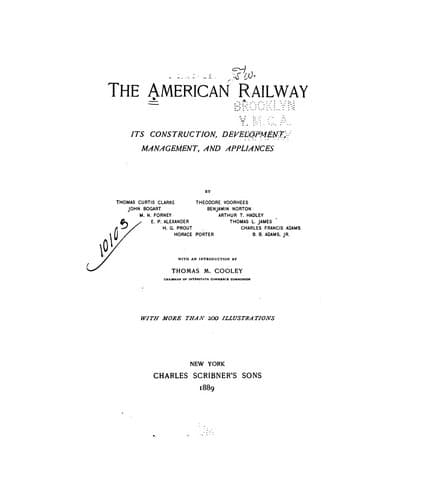
The American Railway: Its Construction, Development, Management, and AppliancesClarke, Thomas Curtis
History
The American Railway: Its Construction, Development, Management, and Appliances
Clarke, Thomas Curtis
Railroads -- United States
Meantime an equally important contribution to the solution of the
railroad question was being worked out in another quarter. In the
year 1869 the Massachusetts Railroad Commission was established.
Its powers were so slight that it was not regarded as likely to
be an influential public agency. Fortunately it numbered among
its members Charles Francis Adams, Jr.; a man whose efficiency
more than made up for any want of nominal powers. In his hands the
mere power to report became the most effective of all weapons.
Representing at once enlightened public judgment and far-sighted
railroad policy, he did much to bring the two into harmony and
protect the legitimate interests on both sides from short-sighted
misuse for the benefit of either party. The detail of his work is
matter of past history; perhaps its most prominent result was to
introduce to State legislation the idea of a railroad commission
as an administrative body. Those States which had no stringent
laws appointed commissions to take their place; those which had
overstringent ones appointed commissions to use discretion in
applying them. In either case, the existence of a body of men
representing the State, but possessing the technical knowledge
to see what the exigencies of railroad business demanded, was a
protection to all parties concerned.
[Illustration: Charles Francis Adams.]
But matters were rapidly passing beyond the sphere of State
legislation. Each new consolidation of systems, each additional
development of through traffic, made it more impossible to control
railroad policy by the action of individual States. It could only
be done by a development of the law in the United States courts or
by Congressional legislation. The former result was necessarily
slow; each year showed an increased demand for special action on
the part of Congress. But such action was hindered by divergence of
opinion in that body itself. One set of men wished a moderate law,
prohibiting the most serious abuses of railroad power, and enforced
under the discretionary care of a commission. These men were for
the most part not unwilling to see pools legalized if their members
could thereby be held to a fuller measure of responsibility. On the
other hand, the extremists wished to prescribe a system of equal
mileage rates; they would hear of no such thing as a commission,
and hated pools as an invention of the adversary. Between the two
lay a large body of members who had no convictions on the matter,
but were desirous to please everybody and offend nobody--a hard
task in this particular case. It was nearly nine years from the
time Mr. Reagan introduced his first bill when a compromise was
finally effected--largely by the influence of Senator Cullom.
As compromises go, it was a tolerably fair one. The extremists
sacrificed their opposition to a commission, but secured the
prohibition of pools; the disputed points with regard to rates were
left in such a shape that no man knew what the law meant, and each
Public-domain text, read in full here on John Shaqi.
Reviews
Reviews
No reviews yet
Be the first to share your thoughts on this work.
Elsewhere in the archive
Join the Discussion
Join the discussion
Sign in to leave a comment or review.
Sign InorCreate an account