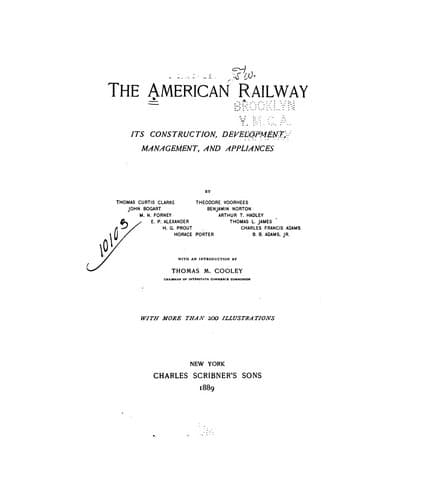
The American Railway: Its Construction, Development, Management, and AppliancesClarke, Thomas Curtis
History
The American Railway: Its Construction, Development, Management, and Appliances
Clarke, Thomas Curtis
Railroads -- United States
Not only should permanent employees be entitled to retain their
position during good behavior, but they should also look forward
to the continual bettering of their condition. That is, apart
from promotion, seniority in the service should carry with it
certain rights and privileges. Take the case of conductors,
brakemen, engineers, machinists, and the like; there seems to be
no reason why length of faithful service should not carry with it
a stipulated increase of pay. If conductors, for example, have
a regular pay of $100 a month, there seems no good reason why
the pay should not increase by steps of $5 with each five years'
service, so that when the conductor has been twenty-five years in
the service his pay should be increased by one-quarter, or $25 a
month. The increase might be more or less. The figures suggested
merely illustrate. So also with the engineer, the brakeman, the
section-man, the machinist. A certain prospect of increased pay, if
a man demeans himself faithfully, is a great incentive to faithful
demeanor. This is another fact which it would be well not to lose
sight of.
There ought likewise to be connected with every large railroad
organization certain funds, contributed partly by the company and
partly by the voluntary action of employees, which would provide
for hospital service, retiring pensions, sick pensions, and
insurance against accident and death. Every man whose name has once
been enrolled in the permanent employ of the company should be
entitled to the benefit of these funds; and he should be deprived
of it only by his own voluntary act, or as the consequence of some
misdemeanor proved before a tribunal. At present the railroad
companies of this country are under no inducement to establish
these mutual insurance societies, or to contribute to them. Their
service, in principle at least, is a shifting service; and so long
as it is shifting the elaborate organizations which are essential
to the safe management of the funds referred to cannot be called
into existence. A tie-up, as it might be called, between the
companies and their employees is a condition precedent. Were this
once effected the rest would follow by steps both natural and easy.
For a company like the Union Pacific to contribute $100,000 a year
to a hospital fund and retiring pension and insurance associations
would be a small matter, if the thing could be so arranged that
the permanent employees themselves would contribute a like sum;
and permanent employees only would contribute at all. Once let
the growth of associations like these begin, and it proceeds with
almost startling rapidity. At the end of ten years the accumulated
capital on the basis of contribution suggested would probably
amount to millions. Every man who was so fortunate as to become
a permanent employee of the company would then be assured of
provision in case of sickness or disability, and his family would
be assured of it in case of his death.
Public-domain text, read in full here on John Shaqi.
Reviews
Reviews
No reviews yet
Be the first to share your thoughts on this work.
Elsewhere in the archive
Join the Discussion
Join the discussion
Sign in to leave a comment or review.
Sign InorCreate an account