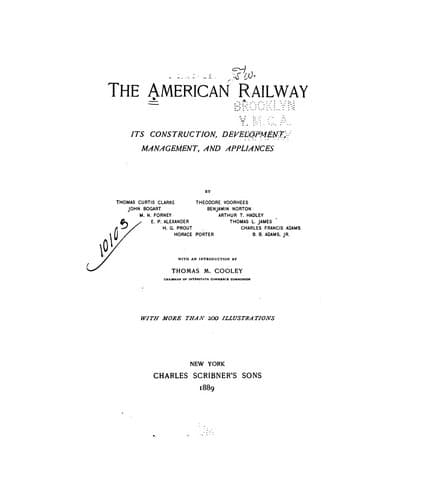
The American Railway: Its Construction, Development, Management, and AppliancesClarke, Thomas Curtis
History
The American Railway: Its Construction, Development, Management, and Appliances
Clarke, Thomas Curtis
Railroads -- United States
The moment a permanent service was thus established it would also
involve further provision of an educational nature. That is, the
companies must continually provide a stock of men for the future.
Where a boy--the son of an employee--grows up always looking
forward to entering the company's service, he becomes to that
company very much what a cadet at West Point or Annapolis is to
the army or the navy of the United States; the idea of loyalty
to the company and of pride in its service grows up with him.
Railroad educational institutions of this sort have already been
created by at least one corporation in the country, and they should
be created by all railroad corporations of the first class. The
children of employees would naturally go into these schools, and
the best of them would at the proper age be sent out upon the
road to take their places in the shops, on the track, or at the
brake. From those thus educated the higher positions in the company
would thereafter be filled. The cost of maintaining these schools,
at least in part, would become a regular item in the operating
expenses of the road. Properly handled, a vast economy would be
effected through them. The morale of the service would gradually
be raised, and the morale of a railroad is, if properly viewed, no
less important than the morale of an army or navy. It is invaluable.
But it is futile to suppose that such a service as that outlined
could be organized, in America at least, unless those concerned in
it were allowed a voice in its management. Practically the most
important feature of the whole is therefore yet to be considered.
How is the employee to be assured a voice in the management of
these joint interests, without bringing about demoralization?
No one has yet had the courage to face this question; and yet
it is a question which must be faced if a solution of existing
difficulties is to be found. If the employees contribute to the
insurance and other funds, it is right that they should have a
voice in the management of those funds. If an employee holds his
situation during good behavior, he has a right to be heard in the
organization of the board which, in case of his suspension for
alleged cause, is to pass upon his behavior. No system will succeed
which does not recognize these rights. In other words, it will be
impossible to establish perfectly good faith and the highest morale
in the service of the companies until the problem of giving this
voice to employees, and giving it effectively, is solved. It can be
solved in but one way: that is, by representation. To solve it may
mean industrial peace.
Public-domain text, read in full here on John Shaqi.
Reviews
Reviews
No reviews yet
Be the first to share your thoughts on this work.
Elsewhere in the archive
Join the Discussion
Join the discussion
Sign in to leave a comment or review.
Sign InorCreate an account