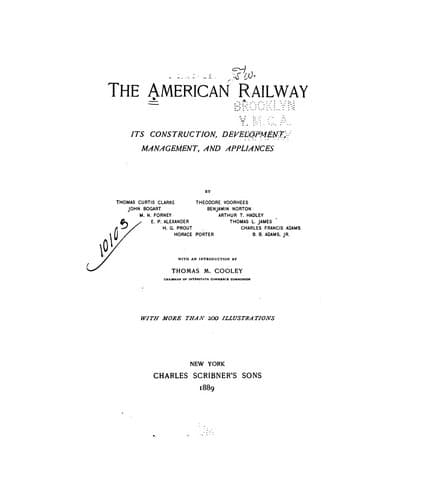
The American Railway: Its Construction, Development, Management, and AppliancesClarke, Thomas Curtis
History
The American Railway: Its Construction, Development, Management, and Appliances
Clarke, Thomas Curtis
Railroads -- United States
The difficulty of always finding the ideal person when wanted has
led to the employment of men of good address who have had little or
no training on freight trains; so that we find some conductors who
are able to deal with all sorts of passengers with a good degree
of success, but who are far from brilliant as managers of trains,
technically speaking; while others, who from their early experience
have first-class executive ability, are slow in discarding the
somewhat rough habits of the freight train. While there are not
wanting those who strive faithfully to reach the ideal, and succeed
admirably, it may be said that the average conductor retains
more of the severe than of the gentle side of his character, at
least so far as outward behavior goes. The rigid requirements of
his financial superiors, which compel him to actually fight for
his rights with dishonest and stingy passengers, make it almost
impossible that he should be otherwise. Ignorant foreigners, poor
women and girls who have lost their way, and other unfortunates
are, however, encountered often enough to preclude the conductor's
forgetting how to be compassionate.
The heroic element is not wholly lacking in the conductor's
life. The temporary guardianship of several hundred people is
an important trust even in smooth sailing, but the conductor's
possibilities are entirely different from the engineer's. He has so
much to do to attend to the petty wants of passengers that their
remoter but more important interests are not given much thought.
The anxieties of a hundred nervous passengers who terribly dread
the loss of an hour by a missed connection are much more likely to
weigh down a conductor's mind than any thoughts of his duty to them
in a possible emergency that will happen only once in five years.
And yet the last-mentioned contingency is a real one. Only last
year, in the great Eastern blizzard, conductors risked their lives
in protecting their passengers. One spent three or four hours in
travelling a mile and a half to a telegraph-office; in consequence
of the six feet of snow, the blinding storm, and the darkness, he
had to constantly hug a barbed-wire fence to avoid losing his way,
and was on the point of exhaustion when he reached the station.
* * * * *
Public-domain text, read in full here on John Shaqi.
Reviews
Reviews
No reviews yet
Be the first to share your thoughts on this work.
Elsewhere in the archive
Join the Discussion
Join the discussion
Sign in to leave a comment or review.
Sign InorCreate an account