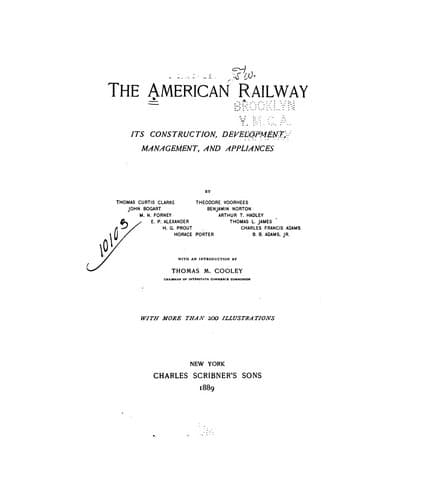
The American Railway: Its Construction, Development, Management, and AppliancesClarke, Thomas Curtis
History
The American Railway: Its Construction, Development, Management, and Appliances
Clarke, Thomas Curtis
Railroads -- United States
The term "station-agent" means, practically, the person in charge
of a small or medium-sized station. When one of these men is
promoted to the charge of a large city station, either freight or
passenger, he becomes really a local superintendent, his duties
then consisting very largely in the supervision of an army of
clerks and laborers who must, each in his place, be as capable
as the agent himself. The agent at a small station has a great
multiplicity of duties to perform. He must sell tickets, be a good
book-keeper, and a faithful switch-tender. He generally must be
a telegraph-operator and must be vigorous physically. He must be
ready, like the conductor, to submit to some abuse from ill-bred
customers, and should be the peer of the business men of his town.
He often encounters almost as great a variety of knotty problems
as the superintendent himself, though he has the advantage that
he can generally turn them over to a superior if he feels unequal
to them. The practical difficulties that most beset him are those
incident to doing everything in a hurry. People who buy tickets
wait until the train is about to start before presenting themselves
at the office. Then the agent has a dozen other things to attend
to, and must therefore detect counterfeit ten-dollar bills with
the expertness of a Washington treasury-clerk. Just as a train
reaches his station the train despatcher's click is heard on the
wires, and he must drop everything and receive (for the conductor)
a telegram in which an error of a single word would very likely
involve the lives of passengers. At a very small station the
checking of baggage devolves on the agent, his overburdened back
being thus loaded with one more straw. He is in many cases agent
for the express company, and so must count, seal, superscribe, and
way-bill money packages and handle oyster-kegs and barrels of beer
at a moment's notice. Women with wagon-loads of loose household
effects to go by freight, and shippers of car-loads of cattle, for
which a car must be specially fitted up, will appear just as the
distracted station-man is receiving a telegram with one side of
his brain and selling a ticket with the other. The household goods
must be weighed and tagged, the sewing-machine tied up, and tables
repaired; the cattle-shipper must be given a short lecture on the
legal bearings of the bargain for transportation which he is about
to make, and his demand that his live-stock shall be carried 500
miles more quickly than human animals are taken over the same road
is to be gently repressed. It is not every day that a small station
is enlivened by this sort of excitement, yet it is common, and is
familiar to every station agent. The variety in the duties of this
position is, however, a great advantage to the ambitious young
man, because it serves to give him a good lift toward a valuable
business education. He can learn about the methods and knacks and
tricks of many different kinds of business, and can profit by
Public-domain text, read in full here on John Shaqi.
Reviews
Reviews
No reviews yet
Be the first to share your thoughts on this work.
Elsewhere in the archive
Join the Discussion
Join the discussion
Sign in to leave a comment or review.
Sign InorCreate an account