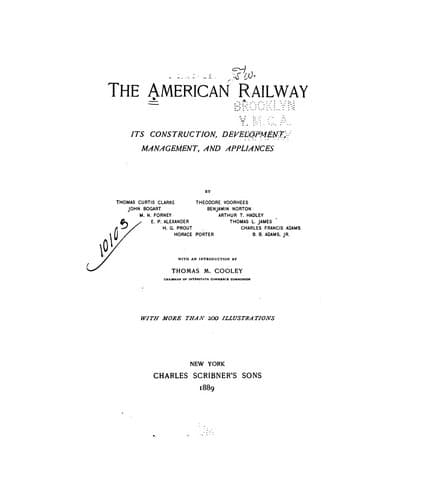
The American Railway: Its Construction, Development, Management, and AppliancesClarke, Thomas Curtis
History
The American Railway: Its Construction, Development, Management, and Appliances
Clarke, Thomas Curtis
Railroads -- United States
the knowledge thus gained. Thomas J. Potter, the lately deceased
vice-president of the Union Pacific Railway, whose memory it is
proposed to perpetuate by a bronze statue, began his railroad
career as agent at a small station in Iowa. Others of equal ability
and perfection of character have risen from similar places and by
the same means.
[Illustration: In the Waiting Room of a Country Station.]
The agent at a small station catches his breath between trains.
There is then generally ample time for calming the nerves and
preparing for the next onslaught. If he is a telegraph-operator he
can chat with the operators at other stations--a common resource
if the wires are not occupied with more important affairs. In the
class periodicals of operators and railroad men, reference to
this phase of their life may be constantly seen, and incidents
of even romantic interest are not infrequent. Many of the men at
small stations are young and unmarried, while at places where the
business has increased enough to warrant the employment of an
assistant, a young woman to do the telegraphing is frequently the
first helper engaged. With this combination it is unnecessary to
tell what follows. If iron bars and stone walls are things which
Cupid holds in contempt, an electric telegraph wire is the thing
which makes him "snicker right out," if we may use the language
of the circus ring. A distance of 100 miles, instead of being a
barrier, is, under these circumstances, an advantage. There is,
to be sure, a slight disadvantage in the fact that any tender
communication confided to the wires will be liable to fall on
the ears of unfeeling persons at intermediate offices, but the
overcoming of this obstacle provides the agreeable incidental
excitement which is always necessary in genuine love-making. Young
persons (or old, either) can study each other's characters, in
important phases at least, at a distance better than at short
range. The telegraphic mode of sending communications discloses
one's disposition far better than does handwriting. Working on
the same wire with another for a few months enables one to form
judgments of that other's generosity or narrowness, serenity or
excitability, industry or laziness, refinement or boorishness,
kindliness of heart or otherwise, which are quite sure to be
correct judgments. Judgments ripen into attachments, and romances
of the wire are common.
Public-domain text, read in full here on John Shaqi.
Reviews
Reviews
No reviews yet
Be the first to share your thoughts on this work.
Elsewhere in the archive
Join the Discussion
Join the discussion
Sign in to leave a comment or review.
Sign InorCreate an account