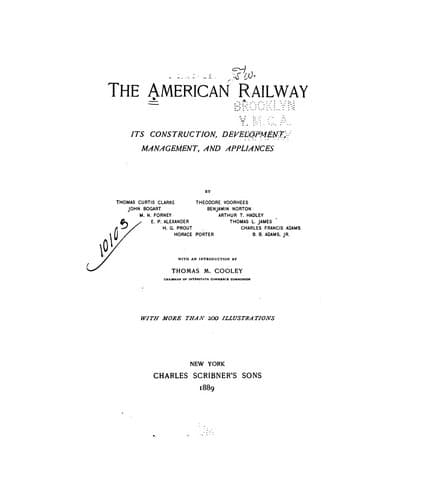
The American Railway: Its Construction, Development, Management, and AppliancesClarke, Thomas Curtis
History
The American Railway: Its Construction, Development, Management, and Appliances
Clarke, Thomas Curtis
Railroads -- United States
At the railroad station next larger in size, the work is more
divided. One man sells tickets, another attends to the freight
office, another to the baggage, and so on. The ticket-seller must
make five-cent bargains with the same urbanity that is given to a
$100 trade, and must be able to toss off the latter in two minutes
if occasion requires, or to spend an hour in helping the passenger
choose the best route among a score of possible ones. The fusillade
of questions that must be met by the ticket-seller every time he
opens his window is familiar to everyone who has ever watched a
place of the kind for ten minutes. The inexperienced traveller
wants to be fully posted as to the exact hour of departure of a
tri-weekly stage with which he is to connect at a railroad station
a thousand miles away, and the more intelligent ones demand an
oral time-table covering the trains for the ensuing week on all
railroads within a radius of 50 miles. Those who cannot read or
understand the time-tables are too modest to ask aid, and their
misfortune is disclosed only after their train has gone and they
are found in tears; while those who can read the table ignore it
and ask questions simply to be sociable.
* * * * *
[Illustration: The Trials of a Baggage-master.]
[Illustration: Station Gardening.]
The station baggage-master has an important but rather thankless
place. He must handle 200-pound trunks with as much ease as though
they contained feathers, and, if he break a moulding off one,
must meet the reproaches of the owner, who imagines that the time
available for handling the trunk was five minutes instead of two
seconds. He must handle much dirty and otherwise unpleasant stuff,
and on the whole pursue a very unpoetic life. He has little to
do with train-handling, but he "keeps in with" the trainmen and
furnishes them with a share of their entertainment. They lounge
in his room sometimes and he keeps on tap a supply of jokes such
as that about the new brakeman who sent to headquarters for a
supply of red oil for his red lantern, and the engineer who lost
time with an excursion train on the Fourth of July because the
extremely hot weather had elongated the rails and thus materially
increased the distance to be travelled over. When "hot boxes"
(friction-heated axles) are given as the cause of a delay the
real cause of which is concealed (by the conductor who is ashamed
of it), the baggage-master gently punctures the deception by
suggesting that perhaps a hot _fire_-box (in the engine) is what
is meant. Whether the roguish clerk of an inexperienced general
manager, who slyly induced his chief to issue an order to station
agents directing that "all freight cars standing for any length of
time on side tracks must be occasionally moved a short distance in
order to prevent flattening of the wheels," had formerly been a
baggage-master, history does not state.
[Illustration: In the Yard at Night.]
Public-domain text, read in full here on John Shaqi.
Reviews
Reviews
No reviews yet
Be the first to share your thoughts on this work.
Elsewhere in the archive
Join the Discussion
Join the discussion
Sign in to leave a comment or review.
Sign InorCreate an account