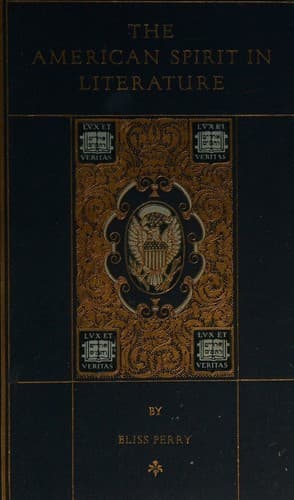
The American Spirit in Literature: A Chronicle of Great InterpretersPerry, Bliss
History
The American Spirit in Literature: A Chronicle of Great Interpreters
Perry, Bliss
American literature -- History and criticism
To appreciate the significance of this theme we must remind ourselves
again of what many persons have called the civic note in our national
writing. Franklin exemplified it in his day. It is far removed from the
pure literary art of a Poe, a Hawthorne, a Henry James. It aims at
action rather than beauty. It seeks to persuade, to convince, to bring
things to pass. We shall observe it in the oratory of Clay and Webster,
as they pleaded for compromise; in the editorials of Garrison, a foe to
compromise and like Calhoun an advocate, if necessary, of disunion; in
the epoch-making novel of Harriet Beecher Stowe; in the speeches of
Wendell Phillips, in verse white-hot with political passion, and sermons
blazing with the fury of attack and defense of principles dear to the
human heart. We must glance, at least, at the lyrics produced by the war
itself, and finally, we shall observe how Abraham Lincoln, the inheritor
of the ideas of Jefferson, Clay, and Webster, perceives and maintains,
in the noblest tones of our civic speech, the sole conditions of our
continuance as a nation.
Let us begin with oratory, an American habit, and, as many besides
Dickens have thought, an American defect. We cannot argue that question
adequately here. It is sufficient to say that in the pioneer stages of
our existence oratory was necessary as a stimulus to communal thought
and feeling. The speeches of Patrick Henry and Samuel Adams were as
essential to our winning independence as the sessions of statesmen and
the armed conflicts in the field. And in that new West which came so
swiftly and dramatically into existence at the close of the Revolution,
the orator came to be regarded as the normal type of intellectual
leadership. The stump grew more potent than schoolhouse and church and
bench.
Public-domain text, read in full here on John Shaqi.
Reviews
Reviews
No reviews yet
Be the first to share your thoughts on this work.
Elsewhere in the archive
Join the Discussion
Join the discussion
Sign in to leave a comment or review.
Sign InorCreate an account