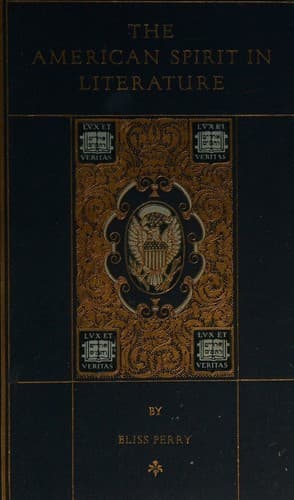
The American Spirit in Literature: A Chronicle of Great InterpretersPerry, Bliss
History
The American Spirit in Literature: A Chronicle of Great Interpreters
Perry, Bliss
American literature -- History and criticism
The very pattern, and, if one likes, the tragic victim of this
glorification of oratory was Henry Clay, "Harry of the West," the
glamour of whose name and the wonderful tones of whose voice became for
a while a part of the political system of the United States. Union and
Liberty were the master-passions of Clay's life, but the greater of
these was Union. The half-educated young immigrant from Virginia
hazarded his career at the outset by championing Anti-Slavery in the
Kentucky Constitutional Convention; the last notable act of his life was
his successful management, at the age of seventy-three, of the futile
Compromise of 1850. All his life long he fought for national issues; for
the War of 1812, for a protective tariff and an "American system," for
the Missouri Compromise of 1820 as a measure for national safety; and he
had plead generously for the young South American republics and for
struggling Greece. He had become the perpetual candidate of his party
for the Presidency, and had gone down again and again in unforeseen and
heart-rending defeat. Yet he could say honorably: "If any one desires to
know the leading and paramount object of my public life, the
preservation of this union will furnish him the key." One could wish
that the speeches of this fascinating American were more readable today.
They seem thin, facile, full of phrases--such adroit phrases as would
catch the ear of a listening, applauding audience. Straight, hard
thinking was not the road to political preferment in Clay's day. Calhoun
had that power, as Lincoln had it. Webster had the capacity for it,
although he was too indolent to employ his great gifts steadily. Yet it
was Webster who analyzed kindly and a little sadly, for he was talking
during Clay's last illness and just before his own, his old rival's
defect in literary quality: "He was never a man of books.... I could
never imagine him sitting comfortably in his library and reading quietly
out of the great books of the past. He has been too fond of
excitement--he has lived upon it; he has been too fond of company, not
enough alone; and has had few resources within himself." Were the
limitations of a typical oratorical temperament ever touched more
unerringly than in these words?
Public-domain text, read in full here on John Shaqi.
Reviews
Reviews
No reviews yet
Be the first to share your thoughts on this work.
Elsewhere in the archive
Join the Discussion
Join the discussion
Sign in to leave a comment or review.
Sign InorCreate an account