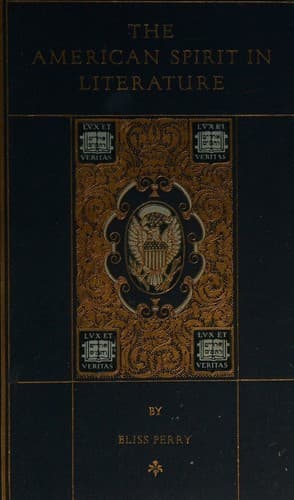
The American Spirit in Literature: A Chronicle of Great Interpreters — John Shaqi
The American Spirit in Literature: A Chronicle of Great InterpretersPerry, Bliss
History
The American Spirit in Literature: A Chronicle of Great Interpreters
Perry, Bliss
American literature -- History and criticism
When the passage of the Stamp Act in 1765 startled the American colonies
out of their provincial sense of security and made them aware of their
real attitude toward the mother country, Franklin was in London. Eleven
years earlier, in 1754, he had offered a plan for the Union of the
Colonies, but this had not contemplated separation from England. It was
rather what we should call a scheme for imperial federation under the
British Crown. We may use his word union, however, in a different field
from that of politics. How much union of sentiment, of mental and moral
life, of literary, educational, and scientific endeavor, was there in
the colonies when the hour of self-examination came? Only the briefest
summary may be attempted here.
As to race, these men of the third and fourth generation since the
planting of the colonies were by no means so purely English as the first
settlers. The 1,600,000 colonists in 1760 were mingled of many stocks,
the largest non-English elements being German and Scotch-Irish--that is,
Scotch who had settled for a while in Ulster before emigrating to
America. "About one-third of the colonists in 1760," says Professor
Channing, "were born outside of America." Crèvecœur's Letters from an
American Farmer thus defined the Americans: "They are a mixture of
English, Scotch, Irish, French, Dutch, Germans, and Swedes. From this
promiscuous breed that race now called Americans has arisen." The
Atlantic seaboard, with a narrow strip inland, was fairly well covered
by local communities, differing in blood, in religion, in political
organization--a congeries of separate experiments or young utopias,
waiting for that most utopian experiment of all, a federal union. But
the dominant language of the "promiscuous breed" was English, and in the
few real centers of intellectual life the English tradition was almost
absolute.
Public-domain text, read in full here on John Shaqi.
Reviews
Reviews
No reviews yet
Be the first to share your thoughts on this work.
Join the Discussion
Join the discussion
Sign in to leave a comment or review.
Sign InorCreate an account