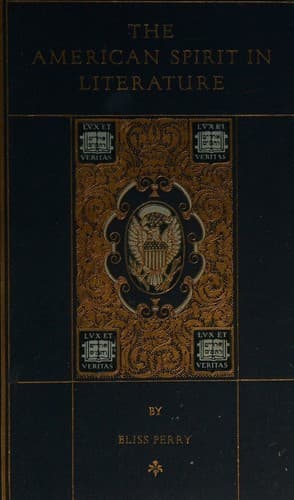
The American Spirit in Literature: A Chronicle of Great InterpretersPerry, Bliss
History
The American Spirit in Literature: A Chronicle of Great Interpreters
Perry, Bliss
American literature -- History and criticism
But it is folly to linger over the limitations of the tallow-chandler's
son. The catalogue of his beneficent activity is a vast one. Balzac once
characterized him as the man who invented the lightning-rod, the hoax,
and the republic. His contributions to science have to do with
electricity, earthquakes, geology, meteorology, physics, chemistry,
astronomy, mathematics, navigation of air and water, agriculture,
medicine, and hygiene. In some of these fields he did pioneer work of
lasting significance. His teachings of thrift and prudence, as
formulated in the maxims of Poor Richard, gave him a world-wide
reputation. He attacked war, like Voltaire, not so much for its
wickedness as for its folly, and cheerfully gave up many years of a long
life to the effort to promote a better understanding among the nations
of the world.
It is perhaps needless to add what all persons who love good writing
know, that Benjamin Franklin was a most delightful writer. His letters
cover an amusing and extraordinary variety of topics. He ranges from
balloons to summer hats, and from the advantages of deep ploughing to
bifocal glasses, which, by the way, he invented. He argues for sharp
razors and cold baths, and for fresh air in the sleeping-room. He
discusses the morals of the game of chess, the art of swimming, the
evils of smoky chimneys, the need of reformed spelling. Indeed, his
passion for improvement led him not only to try his hand upon an
abridgment of the Book of Common Prayer, but to go even so far as to
propose seriously a new rendering of the Lord's Prayer. His famous
proposal for a new version of the Bible, however, which Matthew Arnold
solemnly held up to reprobation, was only a joke which Matthew Arnold
did not see--the new version of Job being, in fact, a clever bit of
political satire against party leadership in England. Even more
brilliant examples of his skill in political satire are his imaginary
Edict of the King of Prussia against England, and his famous Rules for
Reducing a Great Empire to a Small One. But I must not try to call the
roll of all the good things in Franklin's ten volumes. I will simply say
that those who know Franklin only in his Autobiography, charming as that
classic production is, have made but an imperfect acquaintance with the
range, the vitality, the vigor of this admirable craftsman who chose a
style "smooth, clear, and short," and made it serve every purpose of his
versatile and beneficent mind.
Public-domain text, read in full here on John Shaqi.
Reviews
Reviews
No reviews yet
Be the first to share your thoughts on this work.
Join the Discussion
Join the discussion
Sign in to leave a comment or review.
Sign InorCreate an account