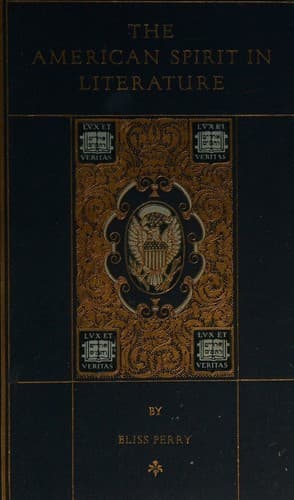
The American Spirit in Literature: A Chronicle of Great Interpreters — John Shaqi
The American Spirit in Literature: A Chronicle of Great InterpretersPerry, Bliss
History
The American Spirit in Literature: A Chronicle of Great Interpreters
Perry, Bliss
American literature -- History and criticism
Jefferson's long life, so varied, so flexible, so responsive to the
touch of popular forces, illustrates the process by which the Virginia
mind of 1743 became the nationalized, unionized mind of 1826. It is
needless here to dwell upon the traits of his personal character: his
sweetness of spirit, his stout-heartedness in disaster, his scorn of
money, his love for the intellectual life. "I have no ambition to govern
men," he wrote to Edward Rutledge. He was far happier talking about
Greek and Anglo-Saxon with Daniel Webster before the fire-place of
Monticello than he ever was in the presidential chair. His
correspondence was enormous. His writings fill twenty volumes. In his
theories of education he was fifty years ahead of his time; in his
absolute trust in humanity he was generations ahead of it. "I am not one
of those who fear the people," he declared proudly. It is because of
this touching faith, this invincible and matchless ardor, that Jefferson
is today remembered. He foreshadowed Lincoln. His belief in the
inarticulate common people is rewarded by their obstinate fidelity to
his name as a type and symbol. "I know of no safe depository of the
ultimate powers of society but the people themselves," wrote Jefferson,
and with the people themselves is the depository of his fame.
CHAPTER V.
The Knickerbocker Group
The Fourth of July orator for 1826 in Cambridge, Massachusetts, was
Edward Everett. Although only thirty-two he was already a distinguished
speaker. In the course of his oration he apostrophized John Adams and
Thomas Jefferson as venerable survivors of that momentous day, fifty
years earlier, which had witnessed our Declaration of Independence. But
even as Everett was speaking, the aged author of the Declaration
breathed his last at Monticello, and in the afternoon of that same day
Adams died also, murmuring, it is said, with his latest breath, and as
if with the whimsical obstinacy of an old man who hated to be beaten by
his ancient rival, "Thomas Jefferson still lives." But Jefferson was
already gone.
Public-domain text, read in full here on John Shaqi.
Reviews
Reviews
No reviews yet
Be the first to share your thoughts on this work.
Join the Discussion
Join the discussion
Sign in to leave a comment or review.
Sign InorCreate an account