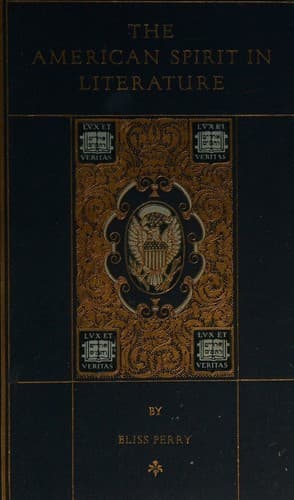
The American Spirit in Literature: A Chronicle of Great Interpreters — John Shaqi
The American Spirit in Literature: A Chronicle of Great InterpretersPerry, Bliss
History
The American Spirit in Literature: A Chronicle of Great Interpreters
Perry, Bliss
American literature -- History and criticism
On the first of August, Everett commemorated the career of the two
Revolutionary leaders, and on the following day a greater than Everett,
Daniel Webster, pronounced the famous eulogy in Faneuil Hall. Never were
the thoughts and emotions of a whole country more adequately voiced than
in this commemorative oratory. Its pulse was high with national pride
over the accomplishments of half a century. "I ask," Everett declared,
"whether more has not been done to extend the domain of civilization, in
fifty years, since the Declaration of Independence, than would have been
done in five centuries of continued colonial subjection?" Webster
asserted in his peroration: "It cannot be denied, but by those who would
dispute against the sun, that with America, and in America, a new era
commences in human affairs. This era is distinguished by free
representative governments, by entire religious liberty, by improved
systems of national intercourse, by a newly awakened and an
unconquerable spirit of free enquiry, and by a diffusion of knowledge
through the community such as has been before altogether unknown and
unheard of."
Was this merely the "tall talk" then so characteristic of American
oratory and soon to be satirized in Martin Chuzzlewit? Or was it
prompted by a deep and true instinct for the significance of the vast
changes that had come over American life since 1776? The external
changes were familiar enough to Webster's auditors: the opening of
seemingly illimitable territory through the Louisiana Purchase, the
development of roads, canals, and manufactures; a rapid increase in
wealth and population; a shifting of political power due to the rise of
the new West--in a word, the evidences of irrepressible national energy.
But this energy was inadequately expressed by the national literature.
The more cultivated Americans were quite aware of this deficiency. It
was confessed by the pessimistic Fisher Ames and by the ardent young men
who in 1815 founded The North American Review. British critics in The
Edinburgh and The Quarterly, commenting upon recent works of travel in
America, pointed out the literary poverty of the American soil. Sydney
Smith, by no means the most offensive of these critics, declared in
1820: "During the thirty or forty years of their independence they have
done absolutely nothing for the sciences, for the arts, for
literature.... In the four quarters of the globe, who reads an American
book? or goes to an American play? or looks at an American picture or
statue?"
Public-domain text, read in full here on John Shaqi.
Reviews
Reviews
No reviews yet
Be the first to share your thoughts on this work.
Join the Discussion
Join the discussion
Sign in to leave a comment or review.
Sign InorCreate an account