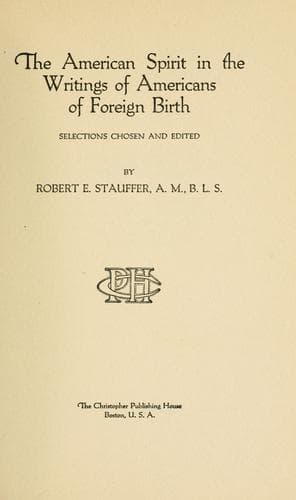
The American Spirit in the Writings of Americans of Foreign Birth — John Shaqi
The American Spirit in the Writings of Americans of Foreign Birth
General
The American Spirit in the Writings of Americans of Foreign Birth
American literature; Americanization; Noncitizens -- United States
This general identity of interests is the only thing that can guarantee
the stability of democratic institutions. Equality of rights,
embodied in general self-government, is the great moral element of
true democracy; it is the only reliable safety-valve in the machinery
of modern society. There is the solid foundation of our system of
government; there is our mission; there is our greatness; there is our
safety; there, and nowhere else! This is true Americanism, and to this
I pay the tribute of my devotion.
EDWIN LAWRENCE GODKIN
Edwin Lawrence Godkin was born of English ancestry at Moyne, County
Wicklow, Ireland, on October 2, 1831. His father, the Rev. James
Godkin, a Presbyterian minister of literary talents, after being
forced from his pulpit for espousing the cause of Young Ireland,
became a journalist of some distinction. The son received his
preparatory education at Armagh, and at Silcoates School, Wakefield,
Yorkshire. In 1846 he entered Queen’s College, Belfast. After
graduating from this institution in 1851, he went to London to study
law at Lincoln’s Inn. After some journalistic experience in the
Crimea and in Belfast, he came to America in 1856 and settled in
New York. His real career began with the founding of _The New York
Nation_ in 1865. His connection with this journal was both long and
distinguished, and his efforts for the encouragement of a sound
and enlightened public opinion have recently been appropriately
recognized in the semi-centenary volume, “Fifty Years of American
Idealism,” edited by Gustav Pollak. He contributed many incisive
essays on political and economic subjects to various magazines.
The most important of these have been collected in three volumes,
“Reflections and Comments,” “Problems of Modern Democracy,” and
“Unforeseen Tendencies of Democracy.” It is from the opening essay of
the second that the following selection is taken.
Public-domain text, read in full here on John Shaqi.
Reviews
Reviews
No reviews yet
Be the first to share your thoughts on this work.
Join the Discussion
Join the discussion
Sign in to leave a comment or review.
Sign InorCreate an account