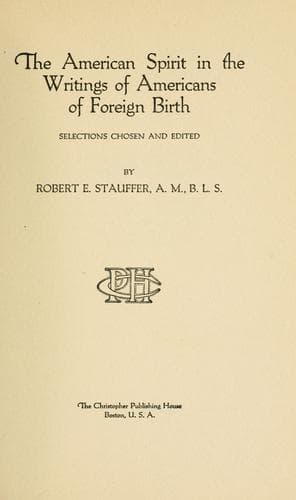
The American Spirit in the Writings of Americans of Foreign Birth
General
The American Spirit in the Writings of Americans of Foreign Birth
American literature; Americanization; Noncitizens -- United States
In the words that I have chosen as my text[9] we have a foreign-born
Roman citizen. Exactly where he was born we do not know; we do know
that he was born outside Roman citizenship. He was, therefore, an
adopted citizen of the Roman Empire, and to this he refers in the words
that I have quoted, “With a great sum obtained I this citizenship.”
There are three implications in these words: the cost of citizenship
to this man; the privilege of citizenship to him; his duty as a Roman
citizen. These three points will be a convenient guide to us in our
discussion of the subject of the morning--“The Foreign-born American
Citizen.”
1. First of all, then, there is the cost to this man of citizenship in
the Roman Empire. He obtained it with a great sum; to get it made him
poor.
There are few among native-born American citizens who understand
the sacrifice made by the foreign-born citizens of the heritage of
childhood and boyhood in the wonder world of early life. There is the
bereavement of the early mystic, unfathomable touch of nature that
comes to one only through one’s native land. Never again to see the sun
rise and set over the dear old hills, with the hero’s mantle like the
bloom of the heather resting upon them, and the shadow of an immemorial
race, is truly a great bereavement. Never again to see the green
pastures, with the flocks quietly feeding in them, under the shade of
the plot of trees here and there mercifully provided by the humanity of
previous generations, nor to hear the music of the river that has sung
into being and out of being forty generations of human lives; never
again to see the fields covered with corn, nor to hear the reaper’s
song among the yellow corn; never again to see the light that welcomed
you when you were born, that smiled on you when you were baptized, that
went with you to school, that watched your play, that constituted the
beautiful, the glorious environment of your early days; never again
to hear the song of the native birds, the skylark in the morning, the
mavis at nightfall, and the wild whistle of the blackbird under the
heat of noon from his thorny den,--all this is simply inexpressible
bereavement. Nature is inwoven with the soul in its earliest years;
its beauty, its wildness, its soul becomes part of the soul of every
deep-hearted human being, and never again can nature be seen as she was
seen through the wonder of life’s morning.
It is this spell of nature over the young soul that gives its exquisite
pathos to Hood’s world-familiar melody:
“I remember, I remember,
The house where I was born,
The little window where the sun
Came peeping in at morn;
He never came a wink too soon.
Nor brought too long a day,
But now I often wish the night
Had borne my breath away!
...
Public-domain text, read in full here on John Shaqi.
Reviews
Reviews
No reviews yet
Be the first to share your thoughts on this work.
Elsewhere in the archive
Join the Discussion
Join the discussion
Sign in to leave a comment or review.
Sign InorCreate an account