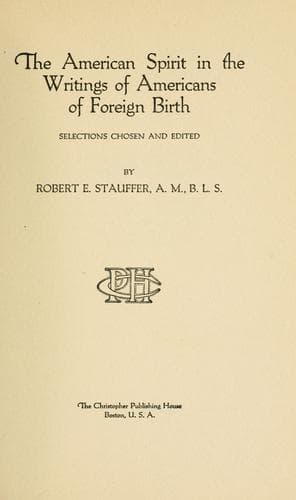
The American Spirit in the Writings of Americans of Foreign Birth
General
The American Spirit in the Writings of Americans of Foreign Birth
American literature; Americanization; Noncitizens -- United States
“I remember, I remember,
The fir trees dark and high;
I used to think their slender tops
Were close against the sky:
It was a childish ignorance,
But now ’tis little joy
To know I’m farther off from heav’n
Than when I was a boy.”
There it is, the mystic, divine influence of nature through the
atmosphere of the country of one’s birth; every immigrant to this
country makes that great surrender.
There is, too, the early humanity. You go down town, you who are
native-born American citizens, and every day you meet those whom you
have known from birth, your earliest playmates and schoolmates, and
those who went to college with you, who entered business with you, who
fought side by side with you through the Great War, who loved what you
loved in early life, revered what you revered, laughed at what you
laughed at and felt as you felt over the glory and the tenderness of
existence. You do not know what they have left behind them who never
see a face that they knew in childhood, who will never meet again, till
time is no more, a schoolmate or an early companion, who will never
gather again in the old home with father and mother and brothers and
sisters; only the most favored have had a fugitive glance, like looking
at a telegraph pole from an express train, of those dear, early faces.
There is a whole world of bereavement of early, tender, beautiful
humanity on the part of all who come here. And this again you hear in
those two verses in “Auld Lang Syne”:--
“We twa hae run about the braes,
And pu’d the gowans fine,
But we’ve wander’d monie a weary foot
Sin’ auld lang syne.
“We twa hae paidl’d in the burn
From morning sun till dine,
But seas between us braid hae roar’d
Sin’ auld lang syne.”
There is due other surrender: there is the suffering of adjustment in
a new country. The first year I spent in Boston, from July, 1871, to
considerably more than July, 1872, I conceived my condition to be as
near that of the spirits in hell as anything I could well imagine! To
be in a city where nobody knew you, where you knew nobody, where so
many wanted to take advantage of the “greenhorn,” to laugh at him if
he ever grew for a moment a bit sentimental, was not exactly heaven.
Many and many a time I went down to the wharf to see the ships with
their white sails, written all over with invisible tidings from the
far, sunny islands left behind, and if I had not been restrained by
shame and pride I should have gone home. That is the experience of
Scandinavian, English, Scotch, Irish, Teuton, Slav, Armenian, Syrian,
and Latin; the great bereavement of nature and of early humanity is
deepened by the sorrow of readjustment in a foreign land. “With a great
sum obtained we this citizenship”; few understand it, few indeed.
Foreign-born American citizenship is preceded by a vast sacrifice, and
you never can understand that sort of citizenship till you take account
of this really profound experience.
Public-domain text, read in full here on John Shaqi.
Reviews
Reviews
No reviews yet
Be the first to share your thoughts on this work.
Elsewhere in the archive
Join the Discussion
Join the discussion
Sign in to leave a comment or review.
Sign InorCreate an account