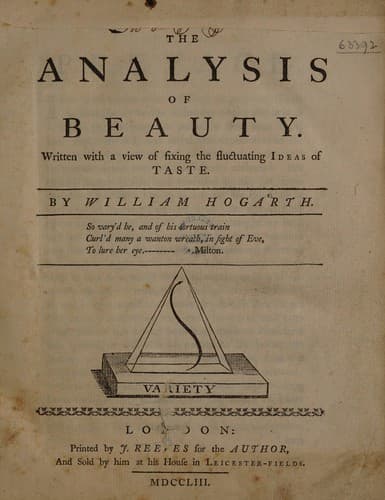
The Analysis of Beauty: Written with a view of fixing the fluctuating ideas of tasteHogarth, William
Philosophy
The Analysis of Beauty: Written with a view of fixing the fluctuating ideas of taste
Hogarth, William
Aesthetics -- Early works to 1800
Another advantage of considering objects thus merely as shells
composed of lines, is, that by these means we obtain the true and full
idea of what is call'd the _out-lines_ of a figure, which has been
confin'd within too narrow limits, by taking it only from drawings
on paper; for in the example of the sphere given above, every one of
the imaginary circular threads has a right to be consider'd as an
out-line of the sphere, as well as those which divide the half, that
is seen, from that which is not seen; and if the eye be supposed to
move regularly round it, these threads will each of them as regularly
succeed one another in the office of out-lines, (in the narrow and
limited sense of the word:) and the instant any one of these threads,
during this motion of the eye, comes into sight on one side, its
opposite thread is lost, and disappears on the other. He who will thus
take the pains of acquiring perfect ideas of the distances, bearings,
and oppositions of several material points and lines in the surfaces of
even the most irregular figures, will gradually arrive at the knack of
recalling them into his mind when the objects themselves are not before
him: and they will be as strong and perfect as those of the most plain
and regular forms, such as cubes and spheres; and will be of infinite
service to those who invent and draw from fancy, as well as enable
those to be more correct who draw from the life.
In this manner, therefore, I would desire the reader to assist his
imagination as much as possible, in considering every object, as if
his eye were placed within it. As straight lines are easily conceiv'd,
the difficulty of following this method in the most simple and regular
forms will be less than may be first imagined; and its use in the more
compounded will be greater: as will be more fully shewn when we come to
speak of composition.
But as [Fig. 2 L p. I] may be of singular use to young designers in
the study of the human form, the most complex and beautiful of all, in
shewing them a mechanical way of gaining the opposite points in its
surface, which never can be seen in one and the same view; it will be
proper to explain the design of it in this place, as it may at the same
time add some weight to what has been already said.
[Illustration: Fig. 2]
Public-domain text, read in full here on John Shaqi.
Reviews
Reviews
No reviews yet
Be the first to share your thoughts on this work.
Join the Discussion
Join the discussion
Sign in to leave a comment or review.
Sign InorCreate an account