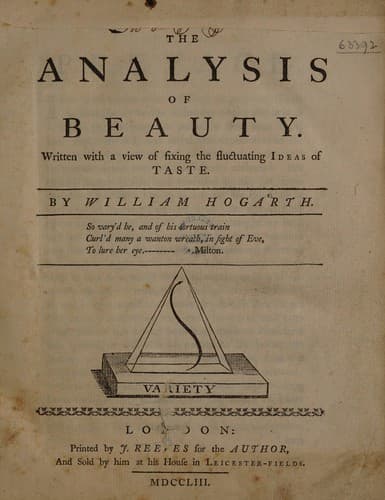
The Analysis of Beauty: Written with a view of fixing the fluctuating ideas of tasteHogarth, William
Philosophy
The Analysis of Beauty: Written with a view of fixing the fluctuating ideas of taste
Hogarth, William
Aesthetics -- Early works to 1800
It represents the trunk of a figure cast in soft wax, with one wire
pass'd perpendicularly through its center, another perpendicularly to
the first, going in before and coming out in the middle of the back,
and as many more as may be thought necessary, parallel to and at equal
distances from these, and each other; as is mark'd by the several
dots in the figure.--Let these wires be so loose as to be taken out
at pleasure, but not before all the parts of them, which appear out
of the wax, are carefully painted close up to the wax, of a different
colour from those, that lie within it. By these means the horizontal
and perpendicular _contents_ of these parts of the body (by which I
mean the distances of opposite points in the surface of these parts)
through which the wires have pass'd, may be exactly known and compared
with each other; and the little holes, where the wires have pierced the
wax, remaining on its surface, will mark out the corresponding opposite
points on the external muscles of the body; as well as assist and guide
us to a readier conception of all the intervening parts. These points
may be mark'd upon a marble figure with calibers properly used.
The known method, many years made use of, for the more exactly and
expeditiously reducing drawings from large pictures, for engravings; or
for enlarging designs, for painting cielings and cupolas, (by striking
lines perpendicular to each other, so as to make an equal number of
squares on the paper design'd for the copy, that hath been first made
on the original; by which means, the situation of every part of the
picture is mechanically seen, and easily transferred) may truly be said
to be somewhat of the same kind with what has been here proposed, but
that one is done upon a flat surface, the other upon a solid; and that
the new scheme differs in its application, and may be of a much more
useful and extensive nature than the old one.
But it is time now to have done with the introduction: and I shall
proceed to consider the fundamental principles, which are generally
allowed to give elegance and beauty, when duly blended together, to
compositions of all kinds whatever; and point out to my readers, the
particular force of each, in those compositions in nature and art,
which seem most to _please and entertain the eye_, and give that grace
and beauty, which is the subject of this enquiry. The principles I
mean, are FITNESS, VARIETY, UNIFORMITY, SIMPLICITY, INTRICACY and
QUANTITY;----_all which co-operate in the production of beauty,
mutually correcting and restraining each other occasionally_.
CHAPTER I.
_Of FITNESS_.
Public-domain text, read in full here on John Shaqi.
Reviews
Reviews
No reviews yet
Be the first to share your thoughts on this work.
Join the Discussion
Join the discussion
Sign in to leave a comment or review.
Sign InorCreate an account