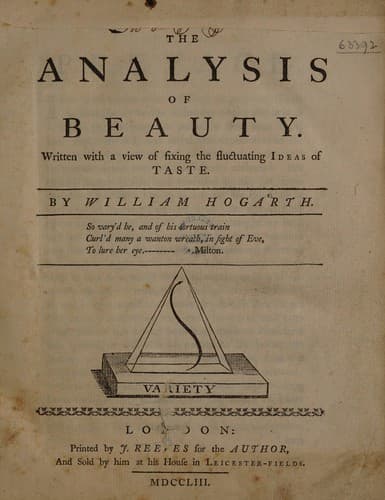
The Analysis of Beauty: Written with a view of fixing the fluctuating ideas of tasteHogarth, William
Philosophy
The Analysis of Beauty: Written with a view of fixing the fluctuating ideas of taste
Hogarth, William
Aesthetics -- Early works to 1800
It will then naturally be asked, why the best painters within these
two centuries, who by their works appear to have excelled in grace
and beauty, should have been so silent in an affair of such seeming
importance to the imitative arts and their own honour? to which I
answer, that it is probable, they arrived at that excellence in their
works, by the mere dint of imitating with great exactness the beauties
of nature, and by often copying and retaining strong ideas of graceful
antique statues; which might sufficiently serve their purposes as
painters, without their troubling themselves with a farther enquiry
into the particular causes of the effects before them. It is not
indeed a little strange, that the great Leonardo da Vinci (amongst the
many philosophical precepts which he hath at random laid down in his
treatise on painting) should not have given the least hint of any thing
tending to a system of this kind; especially, as he was cotemporary
with Michael Angelo, who is said to have discover'd a certain principle
in the trunk only of an antique statue, (well known from this
circumstance by the name of Michael Angelo's Torso, or Back, fig. 54 p.
I) which principle gave his works a grandeur of gusto equal to the best
antiques. Relative to which tradition, Lomazzo who wrote about painting
at the same time, hath this remarkable passage, vol. I. book I.
[Illustration: Fig. 54]
"And because in this place there falleth out a certaine precept of
_Michael Angelo_ much for our purpose, I wil not conceale it, leaving
the farther interpretation and vnderstanding thereof to the iudicious
reader. It is reported then that _Michael Angelo_ vpon a time gaue this
observation to the Painter _Marcus de Sciena_ his scholler; _that he
should alwaies make a figure Pyramidall, Serpentlike, and multiplied
by one two and three_. In which precept (in mine opinion) the whole
mysterie of the arte consisteth. For the greatest grace and life that
a picture can haue, is, that it expresse _Motion_: which the Painters
call the _spirite_ of a picture: Nowe there is no forme so fitte to
expresse this _motion_, as that of the flame of fire, which according
to _Aristotle_ and the other Philosophers, is an elemente most actiue
of all others: because the forme of the flame thereof is most apt for
motion: for it hath a _Conus_ or sharpe pointe wherewith it seemeth to
divide the aire, that so it may ascende to his proper sphere. So that a
picture having this forme will bee most beautifull."[1]
[1] See Haydock's translation printed at Oxford, 1598.
Many writers since Lomazzo have in the same words recommended the
observing this rule also; without comprehending the meaning of it: for
unless it were known systematically, the whole business of grace could
not be understood.
Public-domain text, read in full here on John Shaqi.
Reviews
Reviews
No reviews yet
Be the first to share your thoughts on this work.
Join the Discussion
Join the discussion
Sign in to leave a comment or review.
Sign InorCreate an account