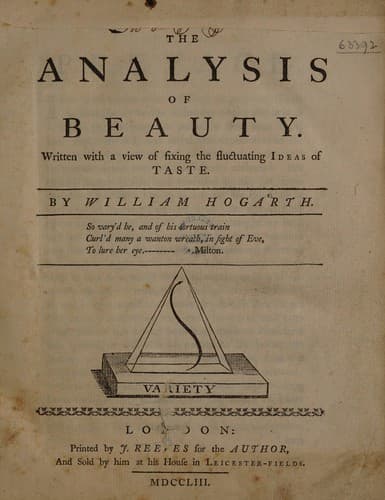
The Analysis of Beauty: Written with a view of fixing the fluctuating ideas of tasteHogarth, William
Philosophy
The Analysis of Beauty: Written with a view of fixing the fluctuating ideas of taste
Hogarth, William
Aesthetics -- Early works to 1800
Du Fresnoy, in his art of painting, says "large flowing, gliding
outlines which are in waves, give not only a grace to the part, but
to the whole body; as we see in the Antinous, and in many other of
the antique figures: a fine figure and its parts ought always to have
a serpent-like and flaming form: naturally those sort of lines have
I know not what of life and seeming motion in them, which very much
resembles the activity of the flame and of the serpent." Now if he had
understood what he had said, he could not, speaking of grace, have
expressed himself in the following contradictory manner.--"But to say
the truth, this is a difficult undertaking, and a rare present, which
the artist rather receives from the hand of heaven than from his own
industry and studies[2]." But De Piles, in his lives of the painters,
is still more contradictory, where he says, "that a painter can only
have it (meaning grace) from nature, and doth not know that he hath it,
nor in what degree, nor how he communicates it to his works: and that
grace and beauty are two different things; beauty pleases by the rules,
and grace without them."
[2] See Dryden's translation of his latin poem on Painting, verse
28, and the remarks on these very lines, page 155, which run thus,
"It is difficult to say what this grace of painting is, it is to be
conceiv'd, and understood much more easy than to be expressed by words;
it proceeds from the illuminations of an excellent mind, (but not to be
acquired) by which we give a certain turn to things, which makes them
pleasing."
All the English writers on this subject have echo'd these passages;
hence _Je ne sçai quoi_, is become a fashionable phrase for grace.
By this it is plain, that this precept which Michael Angelo deliver'd
so long ago in an oracle-like manner, hath remain'd mysterious down to
this time, for ought that has appear'd to the contrary. The wonder that
it should do so will in some measure lessen when we come to consider
that it must all along have appeared as full of contradiction as the
most obscure quibble ever deliver'd at Delphos, because, _winding lines
are as often the cause of deformity as of grace_, the solution of
which, in this place, would be an anticipation of what the reader will
find at large in the body of the work.
[Illustration: Fig. between Figs. 22 and 105]
Public-domain text, read in full here on John Shaqi.
Reviews
Reviews
No reviews yet
Be the first to share your thoughts on this work.
Join the Discussion
Join the discussion
Sign in to leave a comment or review.
Sign InorCreate an account