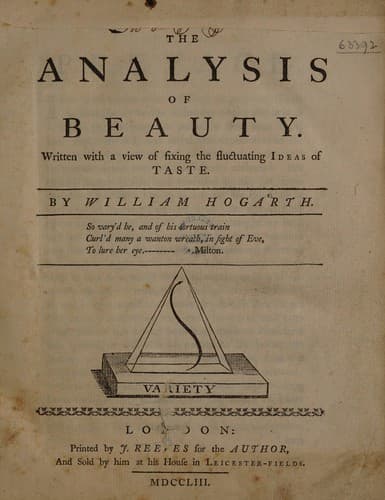
The Analysis of Beauty: Written with a view of fixing the fluctuating ideas of taste — John Shaqi
The Analysis of Beauty: Written with a view of fixing the fluctuating ideas of tasteHogarth, William
Philosophy
The Analysis of Beauty: Written with a view of fixing the fluctuating ideas of taste
Hogarth, William
Aesthetics -- Early works to 1800
To set this matter in somewhat a clearer light, the familiar instance
of a common jack, with a circular fly, may serve our purpose better
than a more elegant form: preparatory to which, let the figure [Fig. 14
T p. I] be consider'd, which represents the eye, at a common reading
distance viewing a row of letters, but fix'd with most attention to the
middle letter A.
[Illustration: Fig. 14]
Now as we read, a ray may be supposed to be drawn from the center of
the eye to that letter it looks at first, and to move successively with
it from letter to letter, the whole length of the line: but if the eye
stops at any particular letter, A, to observe it more than the rest,
these other letters will grow more and more imperfect to the sight, the
farther they are situated on either side of A, as is express'd in the
figure: and when we endeavour to see all the letters in a line equally
perfect at one view, as it were, this imaginary ray must course it to
and fro with great celerity. Thus though the eye, strictly speaking,
can only pay due attention to these letters in succession, yet the
amazing ease and swiftness, with which it performs this task, enables
us to see considerable spaces with sufficient satisfaction at one
sudden view.
Hence, we shall always suppose some such principal ray moving along
with the eye, and tracing out the parts of every form, we mean to
examine in the most perfect manner: and when we would follow with
exactness the course any body takes, that is in motion, this ray is
always to be supposed to move with the body.
In this manner of attending to forms, they will be found, whether
_at rest_, or _in motion_, to give _movement_ to this imaginary ray;
or, more properly speaking, to the eye itself, affecting it _thereby_
more or less _pleasingly_, according to their different _shapes_ and
_motions_. Thus, for example, in the instance of the jack, whether the
eye (with this imaginary ray) moves slowly down the line, to which the
weight is fix'd, or attends to the slow motion of the weight itself,
the mind is equally fatigu'd: and whether it swiftly courses round the
circular rim of the flyer, when the jack stands; or nimbly follows one
point in its circularity whilst it is whirling about, we are almost
equally made giddy by it. But our sensation differs much from either
of these unpleasant ones, when we observe the curling worm, into which
the worm-wheel is fixt [Fig. 15 L p. I]: for this is always pleasing,
either at rest or in motion, and whether that motion is slow or quick.
[Illustration: Fig. 15]
That it is accounted so, when it is _at rest_, appears by the ribbon,
twisted round a stick (represented on one side of this figure) which
has been a long-establish'd ornament in the carvings of frames,
chimney-pieces, and door-cases; and call'd by the carvers, _the stick
and ribbon ornament_: and when the stick, through the middle is
omitted, it is call'd the _ribbon edge_; both to be seen in almost
every house of fashion.
Public-domain text, read in full here on John Shaqi.
Reviews
Reviews
No reviews yet
Be the first to share your thoughts on this work.
Join the Discussion
Join the discussion
Sign in to leave a comment or review.
Sign InorCreate an account