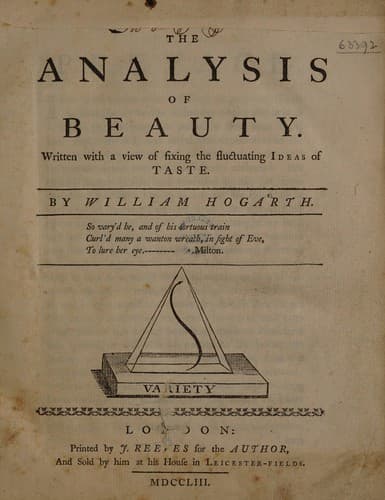
The Analysis of Beauty: Written with a view of fixing the fluctuating ideas of tasteHogarth, William
Philosophy
The Analysis of Beauty: Written with a view of fixing the fluctuating ideas of taste
Hogarth, William
Aesthetics -- Early works to 1800
Could a more elegant simple form than this have been found; it is
probable that judicious architect, Sir Christopher Wren, would not
have chosen the pine-apples for the two terminations of the sides
of the front of St. Paul's: and perhaps the globe and cross, tho' a
finely varied figure, which terminates the dome, would not have had
the preference of situation, if a religious motive had not been the
occasion.
Thus we see simplicity gives beauty even to variety, as it makes it
more easily understood, and should be ever studied in the works of art,
as it serves to prevent perplexity in forms of elegance; as will be
shewn in the next chapter.
CHAPTER V.
_Of INTRICACY_.
The active mind is ever bent to be employ'd. Pursuing is the business
of our lives; and even abstracted from any other view, gives pleasure.
Every arising difficulty, that for a while attends and interrupts the
pursuit, gives a sort of spring to the mind, enhances the pleasure, and
makes what would else be toil and labour, become sport and recreation.
Wherein would consist the joys of hunting, shooting, fishing, and
many other favourite diversions, without the frequent turns and
difficulties, and disappointments, that are daily met with in the
pursuit?--how joyless does the sportsman return when the hare has not
had fair play? how lively, and in spirits, even when an old cunning one
has baffled, and out-run the dogs!
This love of pursuit, merely as pursuit, is implanted in our natures,
and design'd, no doubt, for necessary, and useful purposes. Animals
have it evidently by instinct. The hound dislikes the game he so
eagerly pursues; and even cats will risk the losing of their prey to
chase it over again. It is a pleasing labour of the mind to solve the
most difficult problems; allegories and riddles, trifling as they are,
afford the mind amusement: and with what delight does it follow the
well-connected thread of a play, or novel, which ever increases as the
plot thickens, and ends most pleas'd, when that is most distinctly
unravell'd?
The eye hath this sort of enjoyment in winding walks, and serpentine
rivers, and all sorts of objects, whose forms, as we shall see
hereafter, are composed principally of what, I call, the _waving_ and
_serpentine_ lines.
Intricacy in form, therefore, I shall define to be that peculiarity
in the lines, which compose it, that _leads the eye a wanton kind of
chace_, and from the pleasure that gives the mind, intitles it to the
name of beautiful: and it may be justly said, that the cause of the
idea of grace more immediately resides in this principle, than in the
other five, except variety; which indeed includes this, and all the
others.
That this observation may appear to have a real foundation in nature,
every help will be requir'd, which the reader himself can call to his
assistance, as well as what will here be suggested to him.
Public-domain text, read in full here on John Shaqi.
Reviews
Reviews
No reviews yet
Be the first to share your thoughts on this work.
Join the Discussion
Join the discussion
Sign in to leave a comment or review.
Sign InorCreate an account