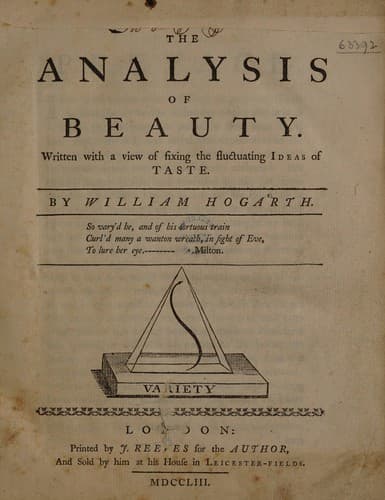
The Analysis of Beauty: Written with a view of fixing the fluctuating ideas of tasteHogarth, William
Philosophy
The Analysis of Beauty: Written with a view of fixing the fluctuating ideas of taste
Hogarth, William
Aesthetics -- Early works to 1800
IV. That taudriness may not destroy the proper effect of variety,
simplicity is call'd in to restrain its superfluities, and is often
very artfully made use of to set native beauty off to more advantage.
I have not known any set of people, that have more excell'd in this
principle of simplicity, or plainness, than the Quakers.
* * * * *
V. Quantity, or fulness in dress has ever been a darling principle;
so that sometimes those parts of dress, which would properly admit of
being extended to a great degree, have been carried into such strange
excesses, that in the reign of Queen Elizabeth a law was made to put a
stop to the growth of ruffs: nor is the enormous size of the hoops at
present, a less sufficient proof of the extraordinary love of quantity
in dress, beyond that of convenience or elegance.
* * * * *
VI. The beauty of intricacy lies in contriving winding shapes, such as
the antique lappets belonging to the head of the sphinx [Fig. 21 p. I],
or as the modern lappet when it is brought before. Every part of dress,
that will admit of the application of this principle, has an air (as it
is term'd) given to it thereby; and altho' it requires dexterity and a
taste to execute these windings well, we find them daily practised with
success.
[Illustration: Fig. 21]
This principle also recommends modesty in dress, to keep up our
expectations, and not suffer them to be too soon gratified. Therefore
the body and limbs should all be cover'd, and little more than certain
hints be given of them thro' the cloathing.
The face indeed will bear a constant view, yet always entertain and
keep our curiosity awake, without the assistance either of a mask, or
veil; because vast variety of changing circumstances keeps the eye
and the mind in constant play, in following the numberless turns of
expression it is capable of. How soon does a face that wants expression
grow insipid, tho' it be ever so pretty?--The rest of the body, not
having these advantages in common with the face, would soon satiate the
eye, were it to be as constantly exposed, nor would it have more effect
than a marble statue. But when it is artfully cloath'd and decorated,
the mind at every turn resumes its imaginary pursuits concerning it.
Thus, if I may be allow'd a simile, the angler chooses not to see the
fish he angles for, until it is fairly caught.
CHAPTER VII.
_Of LINES_.
It may be remember'd that in the introduction, the reader is desired to
consider the surfaces of objects as so many shells of lines, closely
connected together, which idea of them it will now be proper to call to
mind, for the better comprehending not only this, but all the following
chapters on composition.
Public-domain text, read in full here on John Shaqi.
Reviews
Reviews
No reviews yet
Be the first to share your thoughts on this work.
Join the Discussion
Join the discussion
Sign in to leave a comment or review.
Sign InorCreate an account