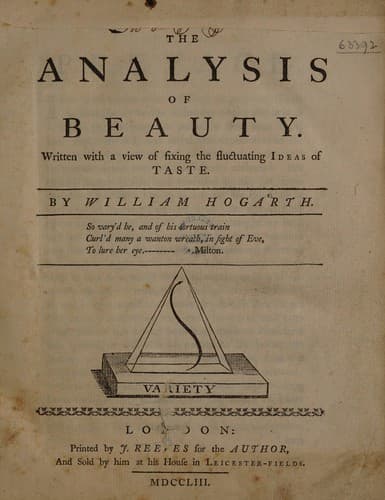
The Analysis of Beauty: Written with a view of fixing the fluctuating ideas of tasteHogarth, William
Philosophy
The Analysis of Beauty: Written with a view of fixing the fluctuating ideas of taste
Hogarth, William
Aesthetics -- Early works to 1800
The constant use made of lines by mathematicians, as well as painters,
in describing things upon paper, hath establish'd a conception of them,
as if actually existing on the real forms themselves. This likewise
we suppose, and shall set out with saying in general--That _the
straight line_, and _the circular line_, together with their different
combinations, and variations, &c. bound, and circumscribe all visible
objects whatsoever, thereby producing such endless variety of forms, as
lays us under the necessity of dividing, and distinguishing them into
general classes; leaving the intervening mixtures of appearances to the
reader's own farther observation.
First, [Fig. 23 T p. I] objects composed of straight lines only, as
the cube, or of circular lines, as the sphere, or of both together, as
cylinders and cones, &c.
[Illustration: Fig. 23]
Secondly, [Fig. 24 T p. I] those composed of straight lines, circular
lines, and of lines partly straight, and partly circular, as the
capitals of columns, and vases, &c.
[Illustration: Fig. 24]
Thirdly, [Fig. 25 T p. I] those composed of all the former together
with an addition of the waving line, which is a line more productive of
beauty than any of the former, as in flowers, and other forms of the
ornamental kind: for which reason we shall call it the line of beauty.
[Illustration: Fig. 25]
Fourthly, [Fig. 26 T p. I] those composed of all the former together
with the serpentine line, as the human form, which line hath the power
of super-adding grace to beauty. Note, forms of most grace have least
of the straight line in them.
[Illustration: Fig. 26]
It is to be observed, that straight lines vary only in length, and
therefore are least ornamental.
That curved lines as they can be varied in their degrees of curvature
as well as in their lengths, begin on that account to be ornamental.
That straight and curv'd lines join'd, being a compound line, vary more
than curves alone, and so become somewhat more ornamental.
That the waving line, or line of beauty, varying still more, being
composed of two curves contrasted, becomes still more ornamental and
pleasing, insomuch that the hand takes a lively movement in making it
with pen or pencil.
And that the serpentine line, by its waving and winding at the same
time different ways, leads the eye in a pleasing manner along the
continuity of its variety, if I may be allowed the expression; and
which by its twisting so many different ways, may be said to inclose
(tho' but a single line) varied contents; and therefore all its
variety cannot be express'd on paper by one continued line, without
the assistance of the imagination, or the help of a figure; see [Fig.
26 T p. I] where that sort of proportion'd, winding line, which will
hereafter be call'd the precise serpentine line, or _line of grace_,
is represented by a fine wire, properly twisted round the elegant and
varied figure of a cone.
CHAPTER VIII.
Public-domain text, read in full here on John Shaqi.
Reviews
Reviews
No reviews yet
Be the first to share your thoughts on this work.
Join the Discussion
Join the discussion
Sign in to leave a comment or review.
Sign InorCreate an account