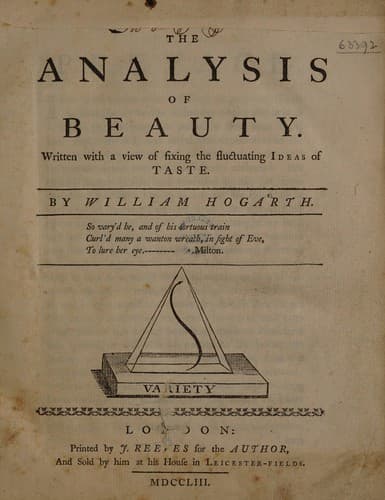
The Analysis of Beauty: Written with a view of fixing the fluctuating ideas of tasteHogarth, William
Philosophy
The Analysis of Beauty: Written with a view of fixing the fluctuating ideas of taste
Hogarth, William
Aesthetics -- Early works to 1800
A still more perfect idea of the effects of the precise waving-line,
and of those lines that deviate from it, may be conceived by the row
of stays, figure [53 B p. I], where number 4 is composed of precise
waving-lines, and is therefore the best shaped stay. Every whale-bone
of a good stay must be made to bend in this manner: for the whole
stay, when put close together behind, is truly a shell of well-varied
contents, and its surface of course a fine form; so that if a line, or
the lace were to be drawn, or brought from the top of the lacing of
the stay behind, round the body, and down to the bottom peak of the
stomacher; it would form such a perfect, precise, serpentine-line,
as has been shewn, round the cone, figure 26 in plate I.----For this
reason all ornaments obliquely contrasting the body in this manner,
as the ribbons worn by the knights of the garter, are both genteel
and graceful. The numbers 5, 6, 7 and 3, 2, 1, are deviations into
stiffness and meanness on one hand, and clumsiness and deformity on the
other. The reasons for which disagreeable effects, after what has been
already said, will be evident to the meanest capacity.
[Illustration: Fig. 26]
It may be worth our notice however, that the stay, number 2, would
better fit a well-shaped man than number 4; and that number 4, would
better fit a well-form'd woman, than number 2; and when on considering
them, merely as to their forms, and comparing them together as you
would two vases, it has been shewn by our principles, how much finer
and more beautiful number 4 is, than number 2: does not this our
determination enhance the merit of these principles, as it proves at
the same time how much the form of a woman's body surpasses in beauty
that of a man?
From the examples that have been given, enough may be gathered to carry
on our observations from them to any other objects that may chance to
come in our way, either animate or inanimate; so that we may not only
_lineally_ account for the ugliness of the toad, the hog, the bear, and
the spider, which are totally void of this waving-line, but also for
the different degrees of beauty belonging to those objects that possess
it.
CHAPTER X.
_Of COMPOSITIONS with the SERPENTINE-LINE_.
The very great difficulty there is in describing this line, either in
words, or by the pencil (as was hinted before, when I first mention'd
it) will make it necessary for me to proceed very slowly in what I have
to say in this chapter, and to beg the reader's patience whilst I lead
him step by step into the knowledge of what I think the sublime in
form, so remarkably display'd in the human body; in which, I believe,
when he is once acquainted with the idea of them, he will find this
species of lines to be principally concern'd.
First, then, let him consider fig. [56 B p. II], which represents a
straight horn, with its contents, and he will find, as it varies like
the cone, it is a form of some beauty, merely on that account.
[Illustration: Fig. 56]
Public-domain text, read in full here on John Shaqi.
Reviews
Reviews
No reviews yet
Be the first to share your thoughts on this work.
Join the Discussion
Join the discussion
Sign in to leave a comment or review.
Sign InorCreate an account