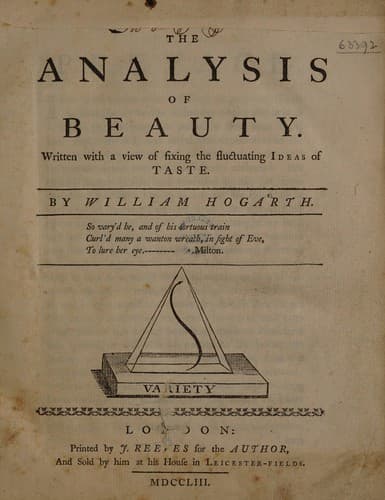
The Analysis of Beauty: Written with a view of fixing the fluctuating ideas of tasteHogarth, William
Philosophy
The Analysis of Beauty: Written with a view of fixing the fluctuating ideas of taste
Hogarth, William
Aesthetics -- Early works to 1800
There are many other churches of great beauty, the work of the same
architect, which are hid in the heart of the city, whose steeples
and spires are raised higher than ordinary, that they may be seen at
a distance above the other buildings; and the great number of them
dispers'd about the whole city, adorn the prospect of it, and give it
an air of opulence and magnificence: on which account their shapes will
be found to be particularly beautiful. Of these, and perhaps of any in
Europe, St. Mary-le-Bow is the most elegantly varied. St. Bride's in
Fleet-street diminishes sweetly by elegant degrees, but its variations,
tho' very curious when you are near them, not being quite so bold, and
distinct, as those of Bow, it too soon looses variety at a distance.
Some gothic spires are finely and artfully varied, particularly the
famous steeple of Strasburg.
Westminster-Abbey is a good contrast to St. Paul's, with regard to
simplicity and distinctness, the great number of its filligrean
ornaments, and small divided and subdivided parts appear confused
when nigh, and are totally lost at a moderate distance; yet there is
nevertheless such a consistency of parts altogether in a good gothic
taste, and such propriety relative to the gloomy ideas, they were then
calculated to convey, that they have at length acquir'd an establish'd
and distinct character in building. It would be look'd upon as an
impropriety and as a kind of profanation to build places for mirth and
entertainment in the same taste.
CHAPTER IX.
_Of COMPOSITION with the WAVING-LINE_.
There is scarce a room in any house whatever, where one does not see
the waving-line employ'd in some way or other. How inelegant would
the shapes of all our moveables be without it? how very plain and
unornamental the mouldings of cornices, and chimney-pieces, without the
variety introduced by the _ogee_ member, which is entirely composed of
waving-lines.
[Illustration: Figs. 49 and 50]
Though all sorts of waving-lines are ornamental, when properly applied;
yet, strictly speaking, there is but one precise line, properly to be
called the line of _beauty_, which in the scale of them [Fig. 49 T p.
I] is number 4: the lines 5, 6, 7, by their bulging too much in their
curvature becoming gross and clumsy; and, on the contrary, 3, 2, 1, as
they straighten, becoming mean and poor; as will appear in the next
figure [50 T p. I] where they are applied to the legs of chairs.
[Illustration: Fig. 53]
Public-domain text, read in full here on John Shaqi.
Reviews
Reviews
No reviews yet
Be the first to share your thoughts on this work.
Join the Discussion
Join the discussion
Sign in to leave a comment or review.
Sign InorCreate an account