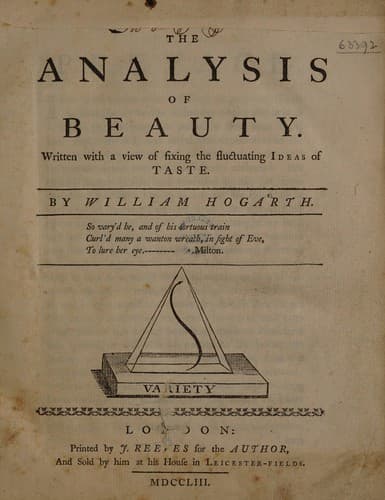
The Analysis of Beauty: Written with a view of fixing the fluctuating ideas of taste — John Shaqi
The Analysis of Beauty: Written with a view of fixing the fluctuating ideas of tasteHogarth, William
Philosophy
The Analysis of Beauty: Written with a view of fixing the fluctuating ideas of taste
Hogarth, William
Aesthetics -- Early works to 1800
Of these fine winding forms then are the muscles and bones composed,
and which, by their varied situations with each other, become more
intricately pleasing, and form a continued waving of winding forms from
one into the other, as may be best seen by examining a good anatomical
figure, part of which you have here represented, in the muscular leg
and thigh, fig. [65 p. I]: which shews the serpentine forms and varied
situations of the muscles, as they appear when the skin is taken off.
It was drawn from a plaster of paris figure cast off nature, the
original of which was prepared for the mould by Cowper, the famous
anatomist. In this last figure, as the skin is taken off the parts are
too distinctly traced by the eye, for that intricate delicacy which is
necessary to the utmost beauty; yet the winding figures of the muscles,
with the variety of their situations, must always be allow'd elegant
forms: however, they lose in the imagination some of the beauty, which
they really have, by the idea of their being flayed; nevertheless,
by what has already been shewn both of them and the bones, the human
frame hath more of its parts composed of serpentine-lines than any
other object in nature; which is a proof both of its superior beauty
to all others, and, at the same time, that its beauty proceeds from
those lines: for although they may be required sometimes to be bulging
in their twists, as in the thick swelling muscles of the Hercules, yet
elegance and greatness of taste is still preserved; but when these
lines lose so much of their twists as to become almost straight, all
elegance of taste vanishes.
Thus fig. [66 p. I], was also taken from nature, and drawn in the same
position, but treated in a more dry, stiff, and what the painters call,
_sticky manner_, than the nature of flesh is ever capable of appearing
in, unless when its moisture is dryed away: it must be allowed, that
the parts of this figure are of as right dimensions, and as truly
situated, as in the former; it wants only the true twist of the lines
to give it taste.
Public-domain text, read in full here on John Shaqi.
Reviews
Reviews
No reviews yet
Be the first to share your thoughts on this work.
Join the Discussion
Join the discussion
Sign in to leave a comment or review.
Sign InorCreate an account