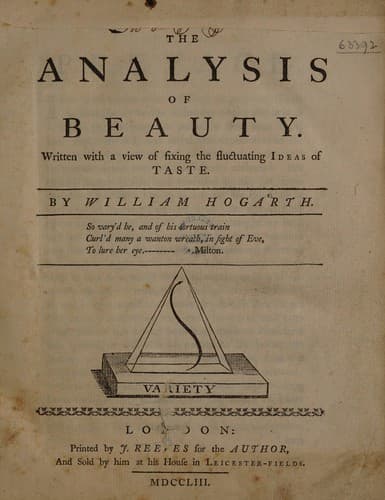
The Analysis of Beauty: Written with a view of fixing the fluctuating ideas of tasteHogarth, William
Philosophy
The Analysis of Beauty: Written with a view of fixing the fluctuating ideas of taste
Hogarth, William
Aesthetics -- Early works to 1800
To prove this further, and to put the mean effect of these plain or
unvaried lines in a stronger light, see fig. [67 p. I], where, by the
uniform, unvaried shapes and situation of the muscles, without so much
as a waving-line in them, it becomes so wooden a form, that he that
can fashion the leg of a joint-stool may carve this figure as well as
the best sculptor. In the same manner, divest one of the best antique
statues of all its serpentine winding parts, and it becomes from an
exquisite piece of art, a figure of such ordinary lines and unvaried
contents, that a common stone-mason or carpenter, with the help of his
rule, calipers, and compasses, might carve out an exact imitation of
it: and were it not for these lines a turner, in his lathe, might turn
a much finer neck than that of the grecian Venus, as according to the
common notion of a beautiful neck, it would be more truly round. For
the same reason, legs much swoln with disease, are as easy to imitate
as a post, having lost their _drawing_, as the painters call it; that
is, having their serpentine-lines all effaced, by the skin's being
equally puffed up, as figure [68].
[Illustration: Fig. 68]
If in comparing these three figures one with another, the reader,
notwithstanding the prejudice his imagination may have conceiv'd
against them, as anatomical figures, has been enabled only to perceive
that one of them is not so disagreeable as the others; he will easily
be led to see further, that this tendency to beauty in one, is not
owing to any greater degree of exactness in the _proportions_ of its
parts, but merely to the more _pleasing turns, and intertwistings of
the lines,_ which compose its external form; for in all the three
figures the same proportions have been observ'd, and, on that account,
they have all an equal claim to beauty.
And if he pursues this anatomical enquiry but a very little further,
just to form a true idea of the elegant use that is made of the
skin and fat beneath it, to conceal from the eye all that is hard
and disagreeable, and at the same time to preserve to it whatever
is necessary in the shapes of the parts beneath, to give grace and
beauty to the whole limb: he will find himself insensibly led into the
principles of that grace and beauty which is to be found in well-turn'd
limbs, in fine, elegant, healthy life, or in those of the best
antique statues; as well as into the reason why his eye has so often
unknowingly been pleased and delighted with them.
Public-domain text, read in full here on John Shaqi.
Reviews
Reviews
No reviews yet
Be the first to share your thoughts on this work.
Join the Discussion
Join the discussion
Sign in to leave a comment or review.
Sign InorCreate an account