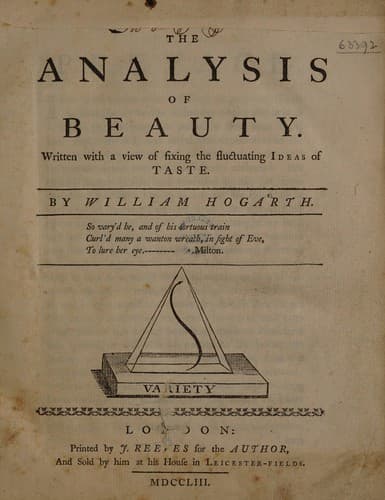
The Analysis of Beauty: Written with a view of fixing the fluctuating ideas of taste — John Shaqi
The Analysis of Beauty: Written with a view of fixing the fluctuating ideas of tasteHogarth, William
Philosophy
The Analysis of Beauty: Written with a view of fixing the fluctuating ideas of taste
Hogarth, William
Aesthetics -- Early works to 1800
Suppose, in the next place, such a wire was in the same manner twisted
round a living well-shaped leg and thigh, or those of a fine statue;
when you take it off you will find no such sharp indentures, nor any of
those regular _engralings_ (as the heralds express it) which displeased
the eye before. On the contrary, you will see how _gradually_ the
changes in its shape are produced; how imperceptibly the different
curvatures run into each other, and how easily the eye glides along
the varied wavings of its sweep. To enforce this still further, if
a line were to be drawn by a pencil exactly where these wires have
been supposed to pass, the point of the pencil, in the muscular leg
and thigh, would perpetually meet with stops and rubs, whilst in the
others it would flow from muscle to muscle along the elastic skin, as
pleasantly as the lightest skiff dances over the gentlest wave.
This idea of the wire, retaining thus the shape of the parts it passes
over, seems of so much consequence, that I would by no means have it
forgot; as it may properly be consider'd as one of the threads (or
outlines) of the shell (or external surface) of the human form: and
the frequently recurring to it will assist the imagination in its
conceptions of those parts of it, whose shapes are most intricately
varied: for the same sort of observations may be made, with equal
justice, on the shapes of ever so many such wires twisted in the same
manner in ever so many directions over every part of a well made man,
woman, or statue.
And if the reader will follow in his imagination the most exquisite
turns of the chisel in the hands of a master, when he is putting the
finishing touches to a statue; he will soon be led to understand what
it is the real judges expect from the hand of such a master, which
the Italians call, the little more, Il poco piu, and which in reality
distinguishes the original master-pieces at Rome from even the best
copies of them.
An example or two will sufficiently explain what is here meant; for
as these exquisite turns are to be found, in some degree of beauty
or other, all over the whole surface of the body and limbs: we may
by taking any one part of a fine figure (though so small a one that
only a few muscles are express'd in it) explain the manner in which so
much beauty and grace has been given to them, as to convince a skilful
artist, almost at sight, that it must have been the work of a master.
[Illustration: Fig. 76]
I have chosen, for this purpose, a small piece of the body of a statue,
fig. [76 T p. II], representing part of the left side under the arm,
together with a little of the breast, (including a very particular
muscle, which, from the likeness its edges bear to the teeth of a saw,
is, if consider'd by itself, void of beauty) as most proper to the
point in hand, because this its regular shape more peculiarly requires
the skill of the artist to give it a little more variety than it
generally has, even in nature.
Public-domain text, read in full here on John Shaqi.
Reviews
Reviews
No reviews yet
Be the first to share your thoughts on this work.
Join the Discussion
Join the discussion
Sign in to leave a comment or review.
Sign InorCreate an account