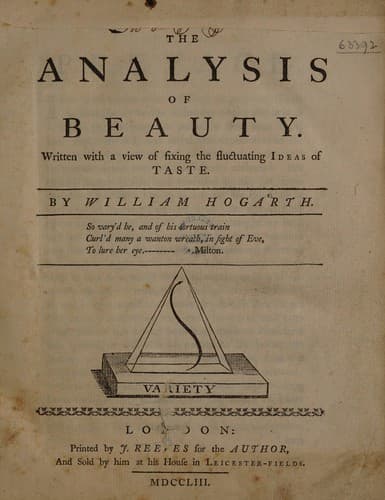
The Analysis of Beauty: Written with a view of fixing the fluctuating ideas of tasteHogarth, William
Philosophy
The Analysis of Beauty: Written with a view of fixing the fluctuating ideas of taste
Hogarth, William
Aesthetics -- Early works to 1800
Thus, in all other parts of the body, as well as these, wherever, for
the sake of the necessary motion of the parts, with proper strength
and agility, the insertions of the muscles are too hard and sudden,
their swellings too bold, or the hollows between them too deep, for
their out-lines to be beautiful; nature most judiciously softens these
hardnesses, and plumps up these vacancies with a proper supply of fat,
and covers the whole with the soft, smooth, springy, and, in delicate
life, almost transparent skin, which, conforming itself to the external
shape of all the parts beneath, expresses to the eye the idea of its
contents with the utmost delicacy of beauty and grace.
The skin, therefore, thus tenderly embracing, and gently conforming
itself to the varied shapes of every one of the outward muscles of the
body, soften'd underneath by the fat, where, otherwise, the same hard
lines and furrows would appear, as we find come on with age in the
face, and with labour, in the limbs, is evidently a shell-like surface
(to keep up the idea I set out with) form'd with the utmost delicacy
in nature; and therefore the most proper subject of the study of every
one, who desires to imitate the works of nature, _as a master should
do_, or to judge of the performances of others _as a real connoisseur
ought_.
I cannot be too long, I think, on this subject, as so much will be
found to depend upon it; and therefore shall endeavour to give a clear
idea of the different effect such anatomical figures have on the eye,
from what the same parts have, when cover'd by the fat and skin; by
supposing a small wire (that has lost its spring and so will retain
every shape it is twisted into) to be held fast to the out-side of the
hip (fig. 65. plate I) and thence brought down the other side of the
thigh obliquely over the calf of the leg, down to the outward ancle
(all the while press'd so close as to touch and conform itself to the
shape of every muscle it passes over) and then to be taken off. If this
wire be now examined it will be found that the general uninterrupted
flowing twist, which the winding round the limbs would otherwise have
given to it, is broken into little better than so many separate plain
curves, by the sharp indentures it every where has receiv'd on being
closely press'd in between the muscles.
[Illustration: Figs. 65, 66 and 67]
Public-domain text, read in full here on John Shaqi.
Reviews
Reviews
No reviews yet
Be the first to share your thoughts on this work.
Join the Discussion
Join the discussion
Sign in to leave a comment or review.
Sign InorCreate an account