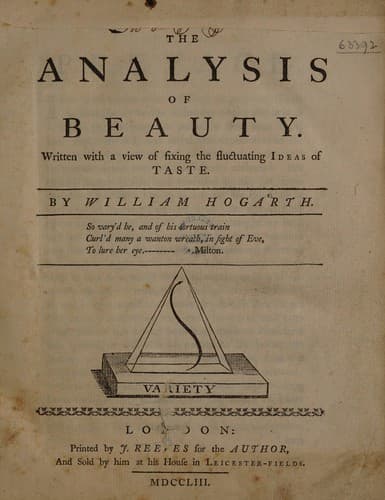
The Analysis of Beauty: Written with a view of fixing the fluctuating ideas of tasteHogarth, William
Philosophy
The Analysis of Beauty: Written with a view of fixing the fluctuating ideas of taste
Hogarth, William
Aesthetics -- Early works to 1800
Now whoever can conceive lines thus constantly flowing, and delicately
varying over every part of the body even to the fingers ends, and will
call to his remembrance what led us to this last description of what
the Italians call, Il poco piu (_the little more_ that is expected from
the hand of a master) will, in my mind, want very little more than what
his own observation on the works of art and nature will lead him to, to
acquire a true idea of the word _Taste_, when applied to form; however
inexplicable this word may hitherto have been imagined.
We have all along had recourse chiefly to the works of the ancients,
not because the moderns have not produced some as excellent; but
because the works of the former are more generally known: nor would
we have it thought, that either of them have ever yet come up to the
utmost beauty of nature. Who but a bigot, even to the antiques, will
say that he has not seen faces and necks, hands and arms in living
women, that even the Grecian Venus doth but coarsely imitate?
And what sufficient reason can be given why the same may not be said of
the rest of the body?
CHAPTER XI.
_Of PROPORTION_.
If anyone should ask, what it is that constitutes a fine-proportion'd
human figure? how ready and seemingly decisive is the common answer: _a
just symmetry and harmony of parts with respect to the whole_. But as
probably this vague answer took its rise from doctrines not belonging
to form, or idle schemes built on them, I apprehend it will cease to be
thought much to the purpose after a proper enquiry has been made.
Preparatory to which, it becomes necessary in this place, to mention
one reason more which may be added to those given in the introduction,
for my having persuaded the reader to consider objects scoop'd out like
thin shells; which is, that partly by this conception, he may be the
better able to separate and keep asunder the two following _general
ideas_, as we will call them, belonging to form; which are apt to
coincide and mix with each other in the mind, and which it is necessary
(for the sake of making each more fully and particularly clear) should
be kept apart, and consider'd singly.
First, the _general ideas_ of what hath already been discussed in the
foregoing chapters, which only comprehends the surface of form, viewing
it in no other light than merely as being ornamental or not.
Secondly, that _general idea_, now to be discussed, which we commonly
have of form altogether, as arising chiefly from a fitness to some
design'd purpose or use.
Hitherto our main drift hath been to establish and illustrate the
first idea only, by shewing, first the nature of variety, and then its
effects on the mind; with the manner how such impressions are made by
means of the different feelings given to the eye, from its movements in
tracing and coursing[5] over surfaces of all kinds.
[5] See Chapter V, page 25.
Public-domain text, read in full here on John Shaqi.
Reviews
Reviews
No reviews yet
Be the first to share your thoughts on this work.
Join the Discussion
Join the discussion
Sign in to leave a comment or review.
Sign InorCreate an account