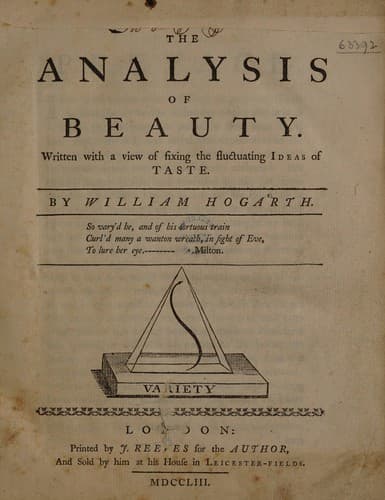
The Analysis of Beauty: Written with a view of fixing the fluctuating ideas of taste — John Shaqi
The Analysis of Beauty: Written with a view of fixing the fluctuating ideas of tasteHogarth, William
Philosophy
The Analysis of Beauty: Written with a view of fixing the fluctuating ideas of taste
Hogarth, William
Aesthetics -- Early works to 1800
The surface of a piece of ornament, that hath every turn in it that
lines are capable of moving into, and at the same time no way applied,
nor of any manner of use, but merely to entertain the eye, would be
such an object as would answer to this first idea alone.
The figure like a leaf, at the bottom of plate I, near to fig. 67, is
something of this kind; it was taken from an ash-tree, and was a sort
of Lusus naturæ, growing only like an excressence, but so beautiful
in the lines of its shell-like windings, as would have been above the
power of a Gibbons to have equalled, even in its own materials; nor
could the graver of an Edlinck, or Drevet, have done it justice on
copper.
[Illustration: Fig. near Fig. 67]
Note, the present taste of ornaments seems to have been partly taken
from productions of this sort, which are to be found about autumn among
plants, particularly asparagus, when it is running to seed.
I shall now endeavour to explain what is included in what I have called
for distinction sake, the second _general idea_ of form, in a much
fuller manner than was done in Chapter I, of Fitness. And begin with
observing, that though surfaces will unavoidably be still included, yet
we must no longer confine ourselves to the particular notice of them as
surfaces only, as we heretofore have done; we must now open our view to
general, as well as particular bulk and solidity; and also look into
what may have filled up, or given rise thereto, such as certain _given_
quantities and dimensions of parts, for inclosing any substance, or for
performing of _motion, purchase, stedfastness,_ and other matters of
use to living beings, which, I apprehend, at length, will bring us to a
tolerable conception of the word _proportion_.
As to these _joint-sensations_ of bulk and motion, do we not at first
sight almost, even without making trial, seem to _feel_ when a leaver
of any kind is too weak, or not long enough to make such or such a
purchase? or when a spring is not sufficient? and don't we find by
experience what weight, or dimension should be given, or taken away, on
this or that account? if so, as the general as well as particular bulks
of form, are made up of materials moulded together under mechanical
directions, for some known purpose or other; how naturally, from these
considerations, shall we fall into a judgment of _fit proportion_;
which is one part of beauty to the mind tho' not always so to the eye.
Public-domain text, read in full here on John Shaqi.
Reviews
Reviews
No reviews yet
Be the first to share your thoughts on this work.
Join the Discussion
Join the discussion
Sign in to leave a comment or review.
Sign InorCreate an account