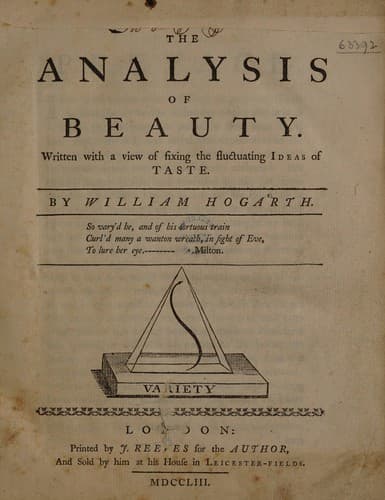
The Analysis of Beauty: Written with a view of fixing the fluctuating ideas of taste — John Shaqi
The Analysis of Beauty: Written with a view of fixing the fluctuating ideas of tasteHogarth, William
Philosophy
The Analysis of Beauty: Written with a view of fixing the fluctuating ideas of taste
Hogarth, William
Aesthetics -- Early works to 1800
It comes then to this, that no longer than whilst we suppose all
the lengths and breadths of the body, or limbs, to be as regular
figures as cylinders, or as the leg, figure 68 in plate I, which is
as round as a rolling-stone, are the measures of lengths to breadths
practicable, or of any use to the knowledge of proportion: so that as
all mathematical schemes are foreign to this purpose, we will endeavour
to root them quite out of our way: therefore I must not omit taking
notice, that Albert Durer, Lomazzo, (see two tasteless figures taken
from their books of proportion [Fig. 55 p. I]) and some others, have
not only puzzled mankind with a heap of minute unnecessary divisions,
but also with a strange _notion_ that those divisions are govern'd by
the laws of music; which mistake they seem to have been led into, by
having seen certain uniform and consonant divisions upon one string
produce harmony to the ear, and by persuading themselves, that similar
distances in lines belonging to form, would, in like manner, delight
the eye. The very reverse of which has been shewn to be true, in
Chapter III, on Uniformity. "The length of the foot," say they, "in
respect to the breadth, makes a _double suprabipartient_, a _diapason_,
and a _diatesseron_[7]:" which, in my opinion, would have been full as
applicable to the ear, or to a plant, or to a tree, or any other form
whatsoever; yet these sort of _notions_ have so far prevail'd by time,
that the words, _harmony of parts_, seem as applicable to form, as to
music.
[7] Note, these authors assure you, that this curious method of
measuring, _will produce beauty far beyond any nature doth afford_.
Lomazzo, recommends also another scheme, with a triangle, to
correct the _poverty of nature_, as they express themselves. These
_nature-menders_ put one in mind of Gulliver's tailor at Laputa,
who, having taken measure of him for a suit of clothes, with a rule,
quadrant, and compasses, after a considerable time spent, brought them
home ill-made.
Notwithstanding the absurdity of the above schemes, such measures
as are to be taken from antique statues, may be of some service to
painters and sculptors, especially to young beginners, but nothing nigh
of such use to them, as the measures, taken the same way, from ancient
buildings, have been, and are, to architects and builders; because the
latter have to do with little else but plain geometrical figures: which
measures, however, serve only in copying what has been done before.
Public-domain text, read in full here on John Shaqi.
Reviews
Reviews
No reviews yet
Be the first to share your thoughts on this work.
Join the Discussion
Join the discussion
Sign in to leave a comment or review.
Sign InorCreate an account