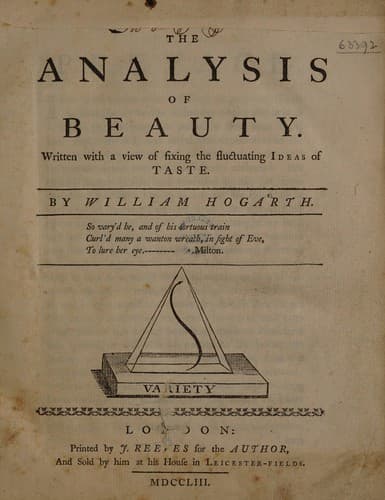
The Analysis of Beauty: Written with a view of fixing the fluctuating ideas of taste — John Shaqi
The Analysis of Beauty: Written with a view of fixing the fluctuating ideas of tasteHogarth, William
Philosophy
The Analysis of Beauty: Written with a view of fixing the fluctuating ideas of taste
Hogarth, William
Aesthetics -- Early works to 1800
The few measures I shall speak of, for the setting out the general
dimensions of a figure, shall be taken by straight lines only, for the
more easy conception of what may indeed be properly call'd, _gaging the
contents of the body_, supposing it solid like a marble statue, as the
wires were described to do [Fig. 2 p. I] in the introduction: by which
plain method, clear ideas may be acquir'd of what _alone_ seem to me to
require measuring, of what certain lengths to what breadths make the
most eligible proportions in general.
[Illustration: Fig. 2]
The most general dimensions of a body, or limbs, are lengths,
breadths, or thicknesses: now the whole gentility of a figure,
according to its character, depends upon the first proportioning these
lines or wires (which are its measures) properly one to another; and
the more varied these lines are, with respect to each other, the more
may the future divisions be varied likewise, that are to be made
on them; and of course the less varied these lines are, the parts
influenced by them, as they must conform themselves to them, must have
less variety too. For example, the exact cross [Fig. 69 R p. II] of two
equal lines, cutting each other in the middle, would confine the figure
of a man, drawn conformable to them, to the disagreeable character
of his being as broad as he is long. And the two lines crossing each
other, to make the height and breadth of a figure, will want variety
a contrary way, by one line being very short in proportion to the
other, and therefore, also incapable of producing a figure of tolerable
variety. To prove this, it will be very easy for the reader to make
the experiment, by drawing a figure or two (tho' ever so imperfectly)
confin'd within such limits.
[Illustration: Fig. 69]
There is a medium between these, proper for every character, which the
eye will easily and accurately determine.
[Illustration: Fig. 70]
Thus, if the lines, fig. [70 R p. II], were to be the measure of the
extreme length and breadth, set out either for the figure of a man or a
vase, the eye soon sees the longest of these is not quite sufficiently
so, in proportion to the other, for a genteel man; and yet it would
make a vase too taper to be elegant; no rule or compasses would decide
this matter either so quickly or so precisely as a good eye. It may be
observed, that minute differences in great lengths, are of little or
no consequence as to proportion, because they are not to be discerned;
for a man is half an inch shorter when he goes to bed at night, than
when he rises in the morning, without the possibility of its being
perceived. In case of a wager the application of a rule or compasses
may be necessary, but seldom on any other occasion.
Public-domain text, read in full here on John Shaqi.
Reviews
Reviews
No reviews yet
Be the first to share your thoughts on this work.
Join the Discussion
Join the discussion
Sign in to leave a comment or review.
Sign InorCreate an account