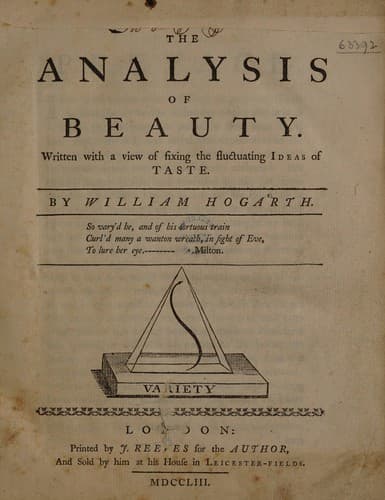
The Analysis of Beauty: Written with a view of fixing the fluctuating ideas of tasteHogarth, William
Philosophy
The Analysis of Beauty: Written with a view of fixing the fluctuating ideas of taste
Hogarth, William
Aesthetics -- Early works to 1800
As the above-mention'd print thus involved me in frequent disputes
by explaining the qualities of the line, I was extremely glad to
find it (which I had conceiv'd as only part of a system in my mind)
so well supported by the above precept of Michael Angelo: which was
first pointed out to me by Dr. Kennedy, a learned antiquarian and
connoisseur, of whom I afterwards purchased the translation, from which
I have taken several passages to my purpose.
Let us now endeavour to discover what light antiquity throws upon the
subject in question.
Egypt first, and afterward Greece, have manifested by their works
their great skill in arts and sciences, and among the rest painting,
and sculpture, all which are thought to have issued from their great
schools of philosophy. Pythagoras, Socrates, and Aristotle, seem to
have pointed out the right road in nature for the study of the painters
and sculptors of those times (which they in all probability afterwards
followed through those nicer paths that their particular professions
required them to pursue) as may be reasonably collected from the
answers given by Socrates to Aristippus his disciple, and Parrhasius
the painter, concerning FITNESS, the first fundamental law in nature
with regard to beauty.
I am in some measure saved the trouble of collecting an historical
account of these arts among the ancients, by accidentally meeting
with a preface to a tract, call'd the _Beau Ideal_: this treatise[3]
was written by Lambert Hermanson Ten Kate, in French, and translated
into English by James Christopher le Blon; who in that preface
says, speaking of the Author, "His superior knowledge that I am now
publishing, is the product of the Analogy of the ancient Greeks; or the
true key for finding all harmonious proportions in painting, sculpture,
architecture, musick, &c. brought home to Greece by Pythagoras. For
after this great philosopher had travell'd into Phoenicia, Egypt and
Chaldea, where he convers'd with the learned; he return'd into Greece
about Anno Mundi 3484. Before the christian æra 520, and brought with
him many excellent discoveries and improvements for the good of his
countrymen, among which the Analogy was one of the most considerable
and useful.
[3] Publish'd in 1732, and sold by A. Millar.
"After him the Grecians, by the help of this Analogy, began (and not
before) to excel other nations in sciences and arts; for whereas before
this time they represented their _Divinities_ in plain human figures,
the Grecians now began to enter into the Beau Ideal; and Pamphilus,
(who flourish'd A. M. 3641, before the christian æra 363, who taught,
that no man could excel in painting without mathematicks) the scholar
of Pausias and master of Apelles, was the first who artfully apply'd
the said Analogy to the art of painting; as much about the same time
the sculpturers, the architects, &c. began to apply it to their several
arts, without which science, the Grecians had remain'd as ignorant as
their forefathers.
Public-domain text, read in full here on John Shaqi.
Reviews
Reviews
No reviews yet
Be the first to share your thoughts on this work.
Join the Discussion
Join the discussion
Sign in to leave a comment or review.
Sign InorCreate an account