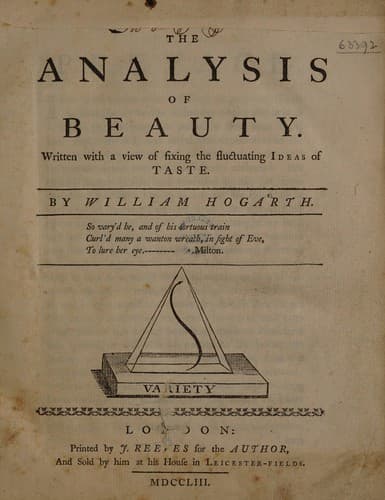
The Analysis of Beauty: Written with a view of fixing the fluctuating ideas of taste — John Shaqi
The Analysis of Beauty: Written with a view of fixing the fluctuating ideas of tasteHogarth, William
Philosophy
The Analysis of Beauty: Written with a view of fixing the fluctuating ideas of taste
Hogarth, William
Aesthetics -- Early works to 1800
But that which may have puzzled this matter most, may be, that Vandyke,
one of the best portrait painters in most respects ever known, plainly
appears not to have had a thought of this kind. For there seems not to
be the least grace in his pictures more than what the life chanced to
bring before him. There is a print of the Dutchess of Wharton (fig. 52,
plate II,) engraved by Van Gunst, from a true picture by him, which is
thoroughly divested of every elegance. Now, had he known this line as
a principle, he could no more have drawn all the parts of this picture
so contrary to it, than Mr. Addison could have wrote a whole spectator
in false grammar; unless it were done on purpose. However, on account
of his other great excellencies, painters chuse to stile this want of
grace in his attitudes, &c. _simplicity_, and indeed they do often very
justly merit that epithet.
[Illustration: Fig. 52]
Nor have the painters of the present times been less uncertain and
contradictory to each other, than the masters already mentioned,
whatever they may pretend to the contrary: of this I had a mind to be
certain, and therefore, in the year 1745, published a frontispiece
to my engraved works, in which I drew a serpentine line lying on a
painter's pallet, with these words under it, THE LINE OF BEAUTY. The
bait soon took; and no Egyptian hierogliphic ever amused more than it
did for a time, painters and sculptors came to me to know the meaning
of it, being as much puzzled with it as other people, till it came to
have some explanation; then indeed, but not till then, some found it
out to be an old acquaintance of theirs, tho' the account they could
give of its properties was very near as satisfactory as that which a
day-labourer who constantly uses the leaver, could give of that machine
as a mechanical power.
Others, as common face painters and copiers of pictures, denied that
there could be such a rule either in art or nature, and asserted it
was all stuff and madness; but no wonder that these gentlemen should
not be ready in comprehending a thing they have little or no business
with. For though the _picture copier_ may sometimes to a common eye
seem to vye with the original he copies, the artist himself requires no
more ability, genius, or knowledge of nature, than a journeyman-weaver
at the goblins, who in working after a piece of painting, bit by
bit, scarcely knows what he is about, whether he is weaving a man or
a horse, yet at last almost insensibly turns out of his loom a fine
piece of tapestry, representing, it may be, one of Alexander's battles
painted by Le Brun.
Public-domain text, read in full here on John Shaqi.
Reviews
Reviews
No reviews yet
Be the first to share your thoughts on this work.
Join the Discussion
Join the discussion
Sign in to leave a comment or review.
Sign InorCreate an account