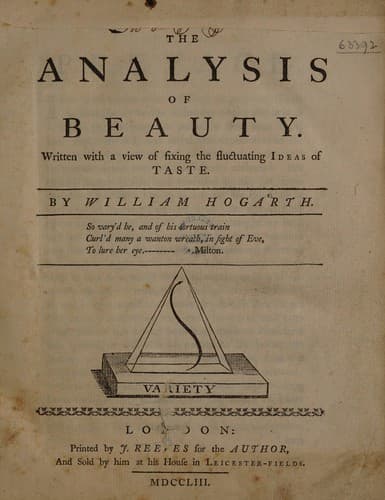
The Analysis of Beauty: Written with a view of fixing the fluctuating ideas of tasteHogarth, William
Philosophy
The Analysis of Beauty: Written with a view of fixing the fluctuating ideas of taste
Hogarth, William
Aesthetics -- Early works to 1800
"The sublime part that I so much esteem, and of which I have begun to
speak, is a real _Je ne sçai quoi_, or an unaccountable something to
most people, and it is the most important part to all the connoisseurs,
I shall call it an harmonious propriety, which is a touching or moving
unity, or a pathetick agreement or concord, not only of each member to
its body, but also of each part to the member of which it is a part:
_It is also an infinite variety of parts_, however conformable, with
respect to each different subject, so that all the attitude, and all
the adjustment of the draperies of each figure ought to answer or
correspond to the subject chosen. Briefly, it is a true decorum, a
bienseance or a congruent disposition of ideas, as well for the face
and stature, as for the attitudes. A bright genius, in my opinion,
who aspires to excel in the ideal, should propose this to himself, as
what has been the principal study of the most famous artists. 'Tis
in this part that the great masters cannot be imitated or copied but
by themselves, or by those that are advanced in the knowledge of the
ideal, and who are as knowing as those masters in the rules or laws of
the pittoresque and poetical nature, altho' inferior to the masters in
the high spirit of invention."
The words in this quotation "_It is also an infinite variety of
parts_," seem at first to have some meaning in them, but it is entirely
destroy'd by the rest of the paragraph, and all the other pages are
filled, according to custom, with descriptions of pictures.
Now, as every one has a right to conjecture what this discovery of the
ancients might be, it shall be my business to shew it was a key to the
thorough knowledge of variety both in form, and movement. Shakespear,
who had the deepest penetration into nature, has sum'd up all the
charms of beauty in two words, INFINITE VARIETY; where, speaking of
Cleopatra's power over Anthony, he says,
----Nor custom stale
Her infinite variety:----Act 2. Scene 3.
It has been ever observed, that the ancients made their doctrines
mysterious to the vulgar, and kept them secret from those who were
not of their particular sects, and societies, by means of symbols,
and hieroglyphics. Lomazzo says, chap. 29, book 1. "The Grecians in
imitation of antiquity searched out the truly renowned proportion,
wherein the exact perfection of most exquisite beauty and sweetness
appeareth; dedicating the same in a triangular glass unto Venus the
goddess of divine beauty, from whence all the beauty of inferior things
is derived."
If we suppose this passage to be authentic, may we not also imagine it
probable, that the symbol in the triangular glass, might be similar to
the line Michael Angelo recommended; especially, if it can be proved,
that the triangular form of the glass, and the serpentine line itself,
are the two most expressive figures that can be thought of to signify
not only beauty and grace, but the whole _order of form_.
Public-domain text, read in full here on John Shaqi.
Reviews
Reviews
No reviews yet
Be the first to share your thoughts on this work.
Join the Discussion
Join the discussion
Sign in to leave a comment or review.
Sign InorCreate an account