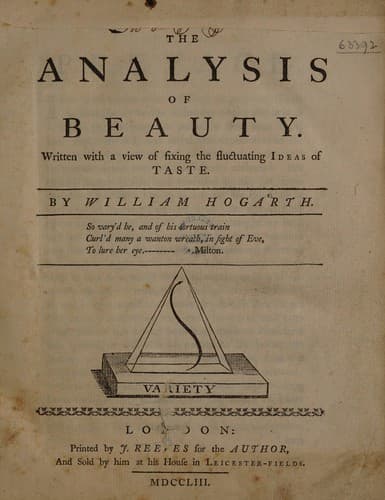
The Analysis of Beauty: Written with a view of fixing the fluctuating ideas of tasteHogarth, William
Philosophy
The Analysis of Beauty: Written with a view of fixing the fluctuating ideas of taste
Hogarth, William
Aesthetics -- Early works to 1800
There is a circumstance in the account Pliny gives of Apelles's
visit to Protogenes, which strengthens this supposition. I hope I may
have leave to repeat the story. Apelles having heard of the fame of
Protogenes, went to Rhodes to pay him a visit, but not finding him at
home asked for a board, on which he drew a _line_, telling the servant
maid, that line would signify to her master who had been to see him;
we are not clearly told what sort of a line it was that could so
particularly signify one of the first of his profession: if it was only
a stroke (tho' as fine as a hair as Pliny seems to think) it could not
possibly, by any means, denote the abilities of a great painter. But if
we suppose it to be a line of some extraordinary quality, such as the
serpentine line will appear to be, Apelles could not have left a more
satisfactory signature of the complement he had paid him. Protogenes
when he came home took the hint, and drew a finer _or rather more
expressive line_ within it, to shew Apelles if he came again, that he
understood his meaning. He, soon returning, was well-pleased with the
answer Protogenes had left for him, by which he was convinced that
fame had done him justice, and so correcting the line again, perhaps
by making it more precisely elegant, he took his leave. The story thus
may be reconcil'd to common sense, which, as it has been generally
receiv'd, could never be understood but as a ridiculous tale.
[Illustration: Fig. over Fig. 4]
Let us add to this, that there is scarce an Egyptian, Greek, or Roman
deity, but hath a twisted serpent, twisted cornucopia, or some symbol
winding in this manner to accompany it. The two small heads (over the
busto of the Hercules, fig. 4, in plate I) of the goddess Isis, one
crowned with a globe between two horns, the other with a lily[4], are
of this kind. Harpocrates, the god of silence, is still more remarkably
so, having a large twisted horn growing out of the side of his head,
one cornucopia in his hand, and another at his feet, with his finger
placed on his lips, indicating secrecy: (see Montfaucon's antiquities)
and it is as remarkable, that the deities of barbarous and gothic
nations never had, nor have to this day, any of these elegant forms
belonging to them. How absolutely void of these turns are the pagods
of China, and what a mean taste runs through most of their attempts in
painting and sculpture, notwithstanding they finish with such excessive
neatness; the whole nation in these matters seem to have but one eye:
this mischief naturally follows from the prejudices they imbibe by
copying one anothers works, which the ancients seem seldom to have done.
[4] The leaves of this flower as they grow, twist themselves various
ways in a pleasing manner, as may be better seen by figure 43, in plate
I, but there is a curious little flower called the Autumn Syclamen,
fig. 47, the leaves of which elegantly twist one way only.
[Illustration: Figs. 43 and 47]
Public-domain text, read in full here on John Shaqi.
Reviews
Reviews
No reviews yet
Be the first to share your thoughts on this work.
Join the Discussion
Join the discussion
Sign in to leave a comment or review.
Sign InorCreate an account