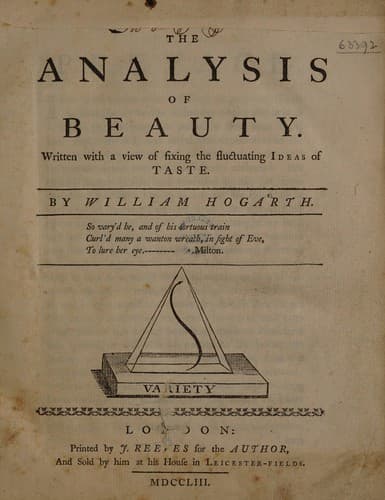
The Analysis of Beauty: Written with a view of fixing the fluctuating ideas of tasteHogarth, William
Philosophy
The Analysis of Beauty: Written with a view of fixing the fluctuating ideas of taste
Hogarth, William
Aesthetics -- Early works to 1800
2. With regard to character and expression; we have daily many
instances which confirm the common received opinion, that the face is
the index of the mind; and this maxim is so rooted in us, we can scarce
help (if our attention is a little raised) forming some particular
conception of the person's mind whose face we are observing, even
before we receive information by any other means. How often is it
said, on the slightest view, that such a one looks like a good-natur'd
man, that he hath an honest open countenance, or looks like a cunning
rogue; a man of sense, or a fool, &c. And how are our eyes riveted
to the aspects of kings and heroes, murderers and saints; and as we
contemplate their deeds, seldom fail making application to their looks.
It is reasonable to believe that aspect to be a true and legible
representation of the mind, which gives everyone the same idea at first
sight; and is afterwards confirm'd in fact: for instance, all concur in
the same opinion, at first sight, of a down-right idiot.
There is but little to be seen by childrens faces, more than that
they are heavy or lively; and scarcely that unless they are in motion.
Very handsom faces of almost any age, will hide a foolish or a wicked
mind till they betray themselves by their actions or their words: yet
the frequent aukward movements of the muscles of the fool's face, tho'
ever so handsom, is apt in time to leave such traces up and down it,
as will distinguish a defect of mind upon examination: but the bad
man, if he be a hypocrite, may so manage his muscles, by teaching them
to contradict his heart, that little of his mind can be gather'd from
his countenance, so that the character of an hypocrite is entirely out
of the power of the pencil, without some adjoining circumstance to
discover him, as smiling and stabbing at the same time, or the like.
It is by the natural and unaffected movements of the muscles, caused
by the passions of the mind, that every man's character would in some
measure be written in his face, by the time he arrives at forty years
of age, were it not for certain accidents which often, tho' not always
prevent it. For the ill-natur'd man, by frequently frowning, and
pouting out the muscles of his mouth, doth in time bring those parts to
a constant state of the appearance of ill-nature, which might have been
prevented by the constant affectation of a smile; and so of the other
passions: tho' there are some that do not affect the muscles at all
simply of themselves, as love and hope.
Public-domain text, read in full here on John Shaqi.
Reviews
Reviews
No reviews yet
Be the first to share your thoughts on this work.
Elsewhere in the archive
Join the Discussion
Join the discussion
Sign in to leave a comment or review.
Sign InorCreate an account