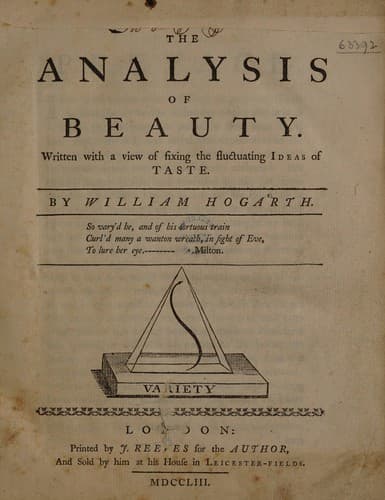
The Analysis of Beauty: Written with a view of fixing the fluctuating ideas of tasteHogarth, William
Philosophy
The Analysis of Beauty: Written with a view of fixing the fluctuating ideas of taste
Hogarth, William
Aesthetics -- Early works to 1800
But least I should be thought to lay too great a stress on outward
shew, like a physiognomist, take this with you, that it is acknowledg'd
there are so many different causes which produce the same kind of
movements and appearances of the features, and so many thwartings by
accidental shapes in the make of faces, that the old adage, fronti
nulla fides, will ever stand its ground upon the whole; and for very
wise reasons nature hath thought fit it should. But, on the other
hand, as in many particular cases, we receive information from the
expressions of the countenance, what follows is meant to give a lineal
description of the language written therein.
It may not be amiss just to look over the passions of the mind, from
tranquillity to extreme despair; as they are in order described in the
common drawing-book, called, Le Brun's passions of the mind; selected
from that great master's works for the use of learners; where you may
have a compendious view of all the common expressions at once. And
altho' these are but imperfect copies, they will answer our purpose in
this place better than any other thing I can refer you to; because the
passions are there ranged in succession, and distinctly marked with
lines only, the shadows being omitted.
Some features are formed so as to make this or that expression
of a passion more or less legible; for example, the little narrow
chinese eye suits a loving or laughing expression best, as a large
full eye doth those of fierceness and astonishment; and round-rising
muscles will appear with some degree of chearfulness even in sorrow:
the features thus suiting with the expressions that have been often
repeated in the face, at length mark it with such lines as sufficiently
distinguish the character of the mind.
The ancients in their lowest characters have shewn as much judgment,
and as great a degree of taste in the management and twisting of the
lines of them, as in their statues of a sublimer kind; in the former
varying only from the precise line of grace in some parts where the
character or action required it. The dying gladiator and the dancing
fawn, the former a slave, the latter a wild clown, are sculptored in
as high a taste of lines as the Antinous or the Apollo; with this
difference, that the precise line of grace abounds more in the two
last: notwithstanding which it is generally allow'd there is equal
merit in the former, as there is near as much judgment required for
the execution of them. Human nature can hardly be represented more
debased than in the character of the Silenus, fig. [107 p. I], where
the bulging-line figure 49, No. 7, runs through all the features of the
face, as well as the other parts of his swinish body: whereas in the
satyr of the wood, tho' the ancients have joined the brute with the
man, we still see preserved an elegant display of serpentine lines,
that make it a graceful figure.
[Illustration: Figs. 107 and 49]
Public-domain text, read in full here on John Shaqi.
Reviews
Reviews
No reviews yet
Be the first to share your thoughts on this work.
Elsewhere in the archive
Join the Discussion
Join the discussion
Sign in to leave a comment or review.
Sign InorCreate an account