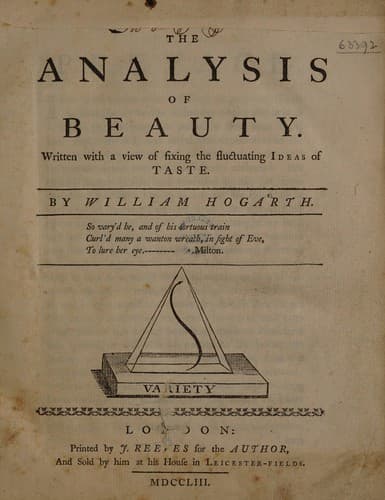
The Analysis of Beauty: Written with a view of fixing the fluctuating ideas of tasteHogarth, William
Philosophy
The Analysis of Beauty: Written with a view of fixing the fluctuating ideas of taste
Hogarth, William
Aesthetics -- Early works to 1800
Indeed the works of art have need of the whole advantage of this line
to make up for its other deficiencies: for tho' in nature's works the
line of beauty is often neglected, or mixt with plain lines, yet so
far are they from being defective on this account, that by this means
there is exhibited that infinite variety of human forms which always
distinguishes the hand of nature from the limited and insufficient
one of art; and as thus she for the sake of variety upon the whole,
deviates sometimes into plain and inelegant lines, if the poor artist
is but able now and then to correct and give a better taste to some
particular part of what he imitates, by having learnt so to do from
her more perfect works, or copying from those that have, ten to one
he grows vain upon it, and fancies himself a nature-mender; not
considering, that even in these, the meanest of her works, she is never
wholly destitute of such lines of beauty and other delicacies, as are
not only beyond his narrow reach, but are seen wanting even in the most
celebrated attempts to rival her. But to return,
As to what we call plain lines, there is this remarkable effect
constantly produced by them, that being more or less conspicuous in any
kind of character or expression of the face, they bring along with them
certain degrees of a foolish or ridiculous aspect.
It is the inelegance of these lines which more properly belonging to
inanimate bodies, and being seen where lines of more beauty and taste
are expected, that renders the face silly and ridiculous. See Chapter
VI, p. 31.
Children in infancy have movements in the muscles of their faces
peculiar to their age, as an uninformed and unmeaning stare, an open
mouth, and simple grin: all which expressions are chiefly formed of
plain curves, and these movements and expressions ideots are apt to
retain; so that in time they mark their faces with these uncouth lines;
and when the lines coincide and agree with the natural forms of the
features, it becomes a more apparent and confirmed character of an
ideot. These plain shapes last mentioned, sometimes happen to people of
the best sense, to some when the features are at rest, to others when
they are put into motion; which a variety of constant regular movements
proceeding from a good understanding, and fashioned by a genteel
education, will often by degrees correct into lines of more elegance.
Public-domain text, read in full here on John Shaqi.
Reviews
Reviews
No reviews yet
Be the first to share your thoughts on this work.
Elsewhere in the archive
Join the Discussion
Join the discussion
Sign in to leave a comment or review.
Sign InorCreate an account