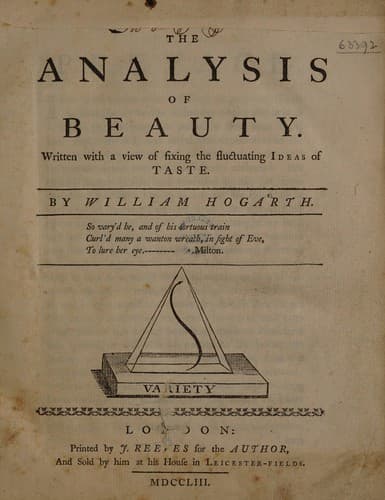
The Analysis of Beauty: Written with a view of fixing the fluctuating ideas of tasteHogarth, William
Philosophy
The Analysis of Beauty: Written with a view of fixing the fluctuating ideas of taste
Hogarth, William
Aesthetics -- Early works to 1800
That particular expression likewise of the face, or movement of a
feature which becomes one person, shall be disagreeable in another,
just as such expressions or turns chance to fall in with lines of
beauty, or the reverse; for this reason there are pretty frowns and
disagreeable smiles: the lines that form a pleasing smile about the
corners of the mouth have gentle windings, as fig. [108 L p. II],
but lose their beauty in the full laugh, as fig. [109 L p. II], the
expression of excessive laughter, oftener than any other, gives a
sensible face a silly or disagreeable look, as it is apt to form
regular plain lines about the mouth, like a parenthesis, which
sometimes appears like crying; as, on the contrary, I remember to
have seen a beggar who had clouted up his head very artfully, and
whose visage was thin and pale enough to excite pity, but his features
were otherwise so unfortunately form'd for his purpose, that what he
intended for a grin of pain and misery, was rather a joyous laugh.
[Illustration: Figs. 108 and 109]
It is strange that nature hath afforded us so many lines and shapes to
indicate the deficiencies and blemishes of the mind, whilst there are
none at all that point out the perfections of it beyond the appearance
of common sense and placidity. Deportment, words, and actions, must
speak the good, the wise, the witty, the humane, the generous, the
merciful, and the brave. Nor are gravity and solemn looks always signs
of wisdom: the mind much occupied with trifles will occasion as grave
and sagacious an aspect, as if it were charged with matters of the
utmost moment; the balance-master's attention to a single point, in
order to preserve his balance, may look as wise at that time as the
greatest philosopher in the depth of his studies. All that the ancient
sculptors could do, notwithstanding their enthusiastic endeavours to
raise the characters of their deities to aspects of sagacity above
human, was to give them features of beauty. Their god of wisdom
hath no more in his look than a handsom manliness; the Jupiter is
carried somewhat higher, by giving it a little more severity than
the Apollo, by a larger prominency of brow gently bending in seeming
thoughtfulness, with an ample beard, which being added to the noble
quantity of its other lines, invests that capital piece of sculpture
with uncommon dignity, which, in the mysterious language of a profound
connoisseur, is stiled a divine idea, inconceivably great, and above
nature.
3dly and lastly, I shall shew in what manner the lines of the face
alter from infancy upwards, and specify the different ages. We are now
to pay most attention to _simplicity_, as the difference of ages we are
about to speak of, turn chiefly upon the use made of this principle in
a greater or less degree, in the form of the lines.
Public-domain text, read in full here on John Shaqi.
Reviews
Reviews
No reviews yet
Be the first to share your thoughts on this work.
Elsewhere in the archive
Join the Discussion
Join the discussion
Sign in to leave a comment or review.
Sign InorCreate an account