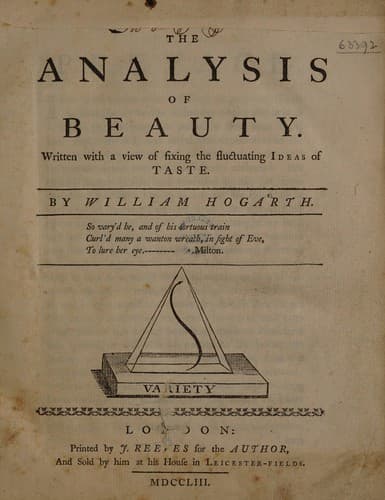
The Analysis of Beauty: Written with a view of fixing the fluctuating ideas of tasteHogarth, William
Philosophy
The Analysis of Beauty: Written with a view of fixing the fluctuating ideas of taste
Hogarth, William
Aesthetics -- Early works to 1800
From infancy till the body has done growing, the contents both of the
body and the face, and every part of their surface, are daily changing
into more variety, till they obtain a certain medium (see page 78 on
proportion) from which medium, as fig. [113 B p. II], if we return back
to infancy, we shall see the variety decreasing, till by degrees that
simplicity in the form, which gave variety its due limits, deviates
into sameness; so that all the parts of the face may be circumscribed
in several circles, as fig. [116 L p. II].
[Illustration: Figs. 113 and 116]
But there is another very extraordinary circumstance, (perhaps never
taken notice of before in this light) which nature hath given us to
distinguish one age from another by; which is, that tho' every feature
grows larger and longer, till the whole person has done growing, the
sight of the eye still keeps its original size; I mean the pupil, with
its iris or ring; for the diameter of this circle continues still the
same, and so becomes a fixt measure by which we, as it were, insensibly
compare the daily perceiv'd growings of the other parts of the face,
and thereby determine a young person's age. You may sometimes find this
part of the eye in a new-born infant, full as large as in a man of six
foot; nay, sometimes larger, see fig. [110 B p. II], [114 B p. II] and
[115 T p. I] which represents three different sizes of the pupil of the
eye; the least, was exactly taken from the eye of a large-featur'd man,
aged 105, the biggest, from one of twenty, who had this part larger
than ordinary, and the other is the common size. If this part of the
eye in the pictures of Charles II. and James II. painted by Vandyke at
Kensington, were to be measured with a pair of compasses, and compared
with their pictures painted by Lilly when they were men, the diameters
would be found in both pictures respectively the same.
[Illustration: Figs. 110, 114 and 115]
In infancy the faces of boys and girls have no visible difference, but
as they grow up the features of the boy get the start, and grow faster
in proportion to the ring of the eye, than those of the girl, which
shews the distinction of the sex in the face. Boys who have larger
features than ordinary, in proportion to the rings of their eyes, are
what we call manly-featured children; as those who have the contrary,
look more childish and younger than they really are. It is this
proportion of the features with the eyes, that makes women, when they
are dressed in mens-cloaths, look so young and boyish: but as nature
doth not always stick close to these particulars, we may be mistaken
both in sexes and ages.
Public-domain text, read in full here on John Shaqi.
Reviews
Reviews
No reviews yet
Be the first to share your thoughts on this work.
Elsewhere in the archive
Join the Discussion
Join the discussion
Sign in to leave a comment or review.
Sign InorCreate an account