_L' Allegro_ and _Il Penseroso_, together with some particular
thoughts, expressions, and rhymes, more especially the idea of a
contrast between these two dispositions, from a forgotten poem prefixed
to the first edition of BURTON'S ANATOMY OF MELANCHOLY, entitled, 'The
Author's Abstract of Melancholy; or, A Dialogue between Pleasure and
Pain.' Here pain is melancholy. It was written, as I conjecture, about
the year 1600. I will make no apology for abstracting and citing as
much of this poem as will be sufficient to prove, to a discerning
reader, how far it had taken possession of Milton's mind. The measure
will appear to be the same; and that our author was at least an
attentive reader of Burton's book, may be already concluded from the
traces of resemblance which I have incidentally noticed in passing
through the _L' Allegro_ and _Il Penseroso_.—After extracting the
lines, Mr. Warton adds, as to the very elaborate work to which these
visionary verses are no unsuitable introduction, the writer's variety
of learning, his quotations from scarce and curious books, his pedantry
sparkling with rude wit and shapeless elegance, miscellaneous matter,
intermixture of agreeable tales and illustrations, and, perhaps, above
all, the singularities of his feelings, clothed in an uncommon
quaintness of style, have contributed to render it, even to modern
readers, a valuable repository of amusement and information.—_Warton's
Milton_, 2d edit. p. 94.
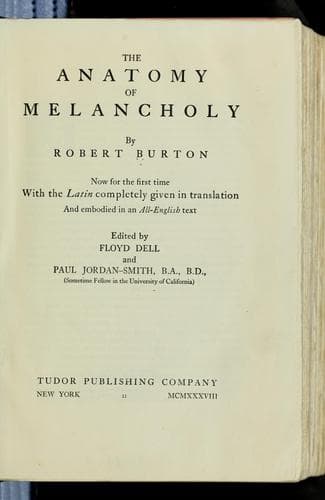
THE ANATOMY OF MELANCHOLY is a book which has been universally read and
admired. This work is, for the most part, what the author himself
styles it, 'a cento;' but it is a very ingenious one. His quotations,
which abound in every page, are pertinent; but if he had made more use
of his invention and less of his commonplace-book, his work would
perhaps have been more valuable than it is. He is generally free from
the affected language and ridiculous metaphors which disgrace most of
the books of his time.—_Granger's Biographical History_.
BURTON'S ANATOMY OF MELANCHOLY, a book once the favourite of the
learned and the witty, and a source of surreptitious learning, though
written on a regular plan, consists chiefly of quotations: the author
has honestly termed it a cento. He collects, under every division, the
opinions of a multitude of writers, without regard to chronological
order, and has too often the modesty to decline the interposition of
his own sentiments. Indeed the bulk of his materials generally
overwhelms him. In the course of his folio he has contrived to treat a
great variety of topics, that seem very loosely connected with the
general subject; and, like Bayle, when he starts a favourite train of
quotations, he does not scruple to let the digression outrun the
principal question. Thus, from the doctrines of religion to military
discipline, from inland navigation to the morality of dancing-schools,
every thing is discussed and determined.—_Ferriar's Illustrations of
Sterne_, p. 58.
Public-domain text, read in full here on John Shaqi.
Reviews
Reviews
No reviews yet
Be the first to share your thoughts on this work.
Join the Discussion
Join the discussion
Sign in to leave a comment or review.
Sign InorCreate an account